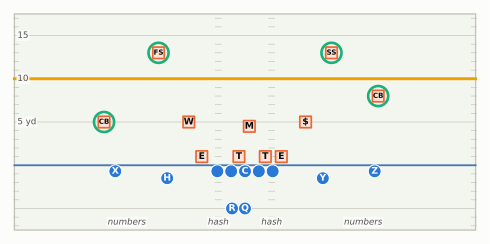
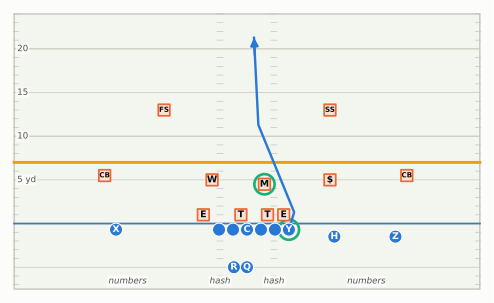
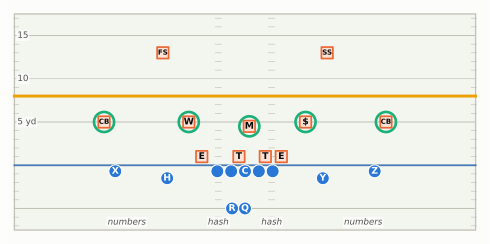
Cover 2 and Tampa 2

Two deep, five under: the zone that keeps everything in front of it, the cornerbacks who refuse to run, the middle linebacker who does, and the holes every offense knows by heart.

Show the Python (shared drawing helpers for this chapter)
import os
import logging

import numpy as np
import pandas as pd
import matplotlib.pyplot as plt
from matplotlib.patches import Patch, FancyArrowPatch, Ellipse
from matplotlib.lines import Line2D

from gridiron import Play, offense, defense, routes as r, show_animation, style, draw_marker

logging.getLogger("matplotlib.font_manager").setLevel(logging.ERROR)
style.apply()
PDF = os.environ.get("RTG_FORMAT", "").lower() in ("pdf", "typst", "print")
FIELD_W = 160 / 3
HALF = FIELD_W / 2          # 26.7 yards from the middle of the field to either sideline


# ---------------------------------------------------------------- alignments used all chapter
def c2_shell(off, corner_d=5.5, corner_out=1.3, safety_d=13.0, safety_w=9.5, press=False):
    """Nickel (4-2-5) two-high shell against `off`. Corners squat 5-7 yards off, a step outside
    the widest receiver on each side (outside leverage); safeties deep and between the hash and
    the numbers; the Will and the nickel ($) split the difference between the tackles and the
    slots; the Mike sits over the ball. press=True walks the corners up to a yard off."""
    wide = [p for p in off if p.pos in ("WR", "TE") and abs(p.w) > 6]
    wl = min(p.w for p in wide if p.w < 0)
    wr = max(p.w for p in wide if p.w > 0)
    cd = 1.2 if press else corner_d
    moves = {"LCB": (cd, wl - corner_out), "RCB": (cd, wr + corner_out),
             "NB": (5.0, 7.0), "WILL": (5.0, -6.5), "MIKE": (4.5, 0.5),
             "FS": (safety_d, -safety_w), "SS": (safety_d, safety_w)}
    out = []
    for p in defense("nickel", "two_high", off):
        if p.key in moves:
            p = p.moved(d=moves[p.key][0], w=moves[p.key][1])
        if p.pos == "CB":
            p = p.moved(label="CB")
        out.append(p)
    return out


def protect(p, rushers=("SDE", "SDT", "WDT", "WDE")):
    """Five linemen set, four rushers engage them: enough to show it is a pass, no more."""
    for k in ("LT", "LG", "C", "RG", "RT"):
        p.block(k, pts=[(-1.2, 0.0)])
    for k in rushers:
        p.rush(k, pts=[(-1.6, 0.0)], speed=2.0)


def no_numbers(ax):
    """Remove the painted yard-line numbers (they sit where wide receivers and corners stand)."""
    for t in list(ax.texts):
        if t.get_alpha() == 0.55:
            t.remove()


def ruler(fld, play, widths=False, fs=6.5, side="left"):
    """Depth labels (yards past the line of scrimmage) down the left edge of the window, and
    optionally where the hash marks and the painted numbers are along the bottom edge.
    gridiron has no ruler, so it is drawn here on the Field's axes."""
    ax = fld.ax
    x_edge = FIELD_W - fld.y1 + 0.35 if side == "left" else FIELD_W - fld.y0 - 0.35
    for d in range(5, 41, 5):
        y = play.los + d
        if fld.x0 + 0.8 <= y <= fld.x1 - 0.8:
            ax.text(x_edge, y, f"{d}" + (" yd" if d == 5 else ""), fontsize=fs, color=style.INK_2,
                    ha=side, va="center", zorder=12,
                    bbox=dict(boxstyle="round,pad=0.12", fc=style.SURFACE, ec="none", alpha=0.85))
    if widths:
        y = fld.x0 + 0.9
        for yb, txt in ((23.58, "hash"), (FIELD_W - 23.58, "hash"), (13.0, "numbers"), (FIELD_W - 13.0, "numbers")):
            if fld.y0 + 2.5 <= yb <= fld.y1 - 2.5:
                ax.text(FIELD_W - yb, y, txt, fontsize=fs, color=style.INK_2, ha="center", va="center",
                        zorder=12, style="italic",
                        bbox=dict(boxstyle="round,pad=0.12", fc=style.SURFACE, ec="none", alpha=0.85))


def pointer(fld, play, text, text_at, to, ha="center", fs=7.5):
    """A labelled arrow from a text box to a spot on the field (both in (d, w) yards)."""
    tx, ty = fld.xy(*play.to_abs(*text_at))
    px, py = fld.xy(*play.to_abs(*to))
    fld.ax.annotate(text, xy=(px, py), xytext=(tx, ty), ha=ha, va="center", fontsize=fs, color=style.INK,
                    zorder=12, arrowprops=dict(arrowstyle="-|>", color=style.INK_2, lw=0.9, shrinkB=6),
                    bbox=dict(boxstyle="round,pad=0.25", fc=style.SURFACE, ec=style.BASELINE, lw=0.6))


def say(fld, play, text, at, fs=7.0, color=None, ha="center", weight="normal", box=True):
    """Plain on-field text at (d, w)."""
    x, y = fld.xy(*play.to_abs(*at))
    fld.ax.text(x, y, text, ha=ha, va="center", fontsize=fs, color=color or style.INK, zorder=12,
                fontweight=weight,
                bbox=dict(boxstyle="round,pad=0.2", fc=style.SURFACE, ec="none", alpha=0.95) if box else None)


def trim(ax):
    """Drop text labels whose anchor lies outside the drawn window (players cropped out of view)."""
    x0, x1 = sorted(ax.get_xlim())
    y0, y1 = sorted(ax.get_ylim())
    for t in list(ax.texts):
        x, y = t.get_position()
        if t.get_transform() == ax.transData and not (x0 <= x <= x1 and y0 <= y <= y1):
            t.remove()


def zlabel(fld, play, text, at, fs=7.0):
    """An italic zone name at (d, w), placed by hand so it never sits on a player."""
    x, y = fld.xy(*play.to_abs(*at))
    fld.ax.text(x, y, text, ha="center", va="center", fontsize=fs, color=style.INK_2, style="italic", zorder=3)


def hole(fld, play, center, size, text, fs=7.2):
    """A green 'thin spot' in the coverage, with its label."""
    cx, cy = fld.xy(*play.to_abs(*center))
    fld.ax.add_patch(Ellipse((cx, cy), size[1], size[0], facecolor=style.THIRD, alpha=0.16,
                             edgecolor=style.THIRD, lw=1.2, zorder=2))
    fld.ax.text(cx, cy, text, ha="center", va="center", fontsize=fs, color=style.INK, fontweight="bold",
                zorder=6)


# ---------------------------------------------------------------- moments of a play, for print
def snapshot(play, t, ax=None, lateral="full", window=(-8.5, 24.0), width_in=6.5, notes=(), show_ruler=False,
             ruler_side="left"):
    """Everyone where he is at time t, with faint trails of where he has been and the ball's flight."""
    pos = {k: play.position(k, t) for k in play.players}
    moved = [pl.moved(d=float(pos[k][0]), w=float(pos[k][1])) for k, pl in play.players.items()]
    q = Play([m for m in moved if m.side == "off"], [m for m in moved if m.side == "def"],
             los=play.los, ball_y=play.ball_y, to_go=play.to_go)
    q.highlights = dict(play.highlights)
    fld = q.draw(ax=ax, lateral=lateral, window=window, width_in=width_in, title=False)
    ax, ppy = fld.ax, fld.pts_per_yard()
    no_numbers(ax)
    if show_ruler:
        ruler(fld, play, fs=5.5, side=ruler_side)
    P = lambda d, w: fld.xy(*play.to_abs(d, w))  # noqa: E731
    start = play._compile()[1]
    for k, pl in play.players.items():
        if pl.side == "off" and pl.pos not in ("WR", "TE", "RB"):
            continue
        pts = np.array([play.position(k, tt) for tt in np.linspace(start, t, 30)])
        if np.ptp(pts[:, 0]) + np.ptp(pts[:, 1]) < 0.3:
            continue
        xs, ys = P(pts[:, 0], pts[:, 1])
        if pl.side == "off":
            ax.plot(xs, ys, color=style.OFFENSE, lw=1.0, alpha=0.45, zorder=3)
        else:
            ax.plot(xs, ys, color=style.DEFENSE, lw=1.3, ls=(0, (3, 2)), zorder=3)
    bx, by = P(*play.ball_position(t))
    for kind, _, t_rel in play.ball_events:
        if kind == "pass" and t > t_rel:
            sx, sy = P(*play.ball_position(t_rel))
            ax.add_patch(FancyArrowPatch((float(sx), float(sy)), (float(bx), float(by)), arrowstyle="-|>",
                                         mutation_scale=8, color=style.BALL, lw=1.4, ls=(0, (2, 1.5)), zorder=9))
    passes = [t_rel for kind, _, t_rel in play.ball_events if kind == "pass"]
    if not passes or t > passes[0]:          # before the throw the ball is in the QB's hands: don't hide him
        draw_marker(ax, float(bx), float(by), "ball", "", ppy)
    for text, at in notes:
        say(fld, play, text, at, fs=6.4)
    trim(ax)
    return fld


def strip(play, times, labels, lateral=(-HALF, HALF), window=(-8.5, 24.0), notes_at=None, width_in=6.5, ncols=2,
          ruler_side="left", extras=None):
    """The print version of an animation: one panel per chosen moment. `extras` maps a panel index to a
    function f(fld) that draws anything else on that panel (a shaded spot, an arrow)."""
    n = len(times)
    nrows = int(np.ceil(n / ncols))
    pw = width_in / ncols
    h = nrows * (pw * (window[1] - window[0]) / abs(lateral[1] - lateral[0]) + 0.32)
    fig, axes = plt.subplots(nrows, ncols, figsize=(width_in, h), squeeze=False)
    for ax in axes.flat[n:]:
        ax.axis("off")
    for i, (ax, t, lab) in enumerate(zip(axes.flat, times, labels)):
        fld = snapshot(play, t, ax=ax, lateral=lateral, window=window, notes=(notes_at or {}).get(i, ()),
                       show_ruler=(i == 0), ruler_side=ruler_side)
        if extras and i in extras:
            extras[i](fld)
        ax.set_title(lab, fontsize=8.5, color=style.INK, loc="left")
    fig.tight_layout(h_pad=0.6, w_pad=0.4)
    h = [Line2D([], [], color=style.DEFENSE, lw=1.3, ls=(0, (3, 2)), label="Defender's path so far"),
         Line2D([], [], color=style.OFFENSE, lw=1.0, alpha=0.6, label="Receiver's path so far"),
         Line2D([], [], color=style.BALL, lw=1.4, ls=(0, (2, 1.5)), label="The ball")]
    fig.legend(handles=h, loc="upper center", bbox_to_anchor=(0.5, 0.0), ncol=3, fontsize=7.5, frameon=False)
    return fig
Third-and-12 near midfield, a minute left in the first half. Both cornerbacks stand five yards off the wide receivers, a step outside them, flat-footed. Both safeties are deep, one on each side of the field. The quarterback throws a quick out to the sideline; the corner closes, tackles, gain of eight, and the offense punts. The analyst sounds almost pleased: “That’s Cover 2 doing its job. Keep everything in front, make the tackle.” Two series later the same corner stands in the same spot, the receiver runs straight past him, and the ball drops into his hands 22 yards downfield, between the corner and the safety, before the safety can get there. “And that’s the hole in Cover 2,” says the analyst. So which is it? Why would a defense build a coverage around a hole it knows is there, and why did one version of that coverage, Tampa 2, become the identity of a generation of NFL defenses and two Super Bowl champions? This chapter takes Cover 2 apart: who stands where, why, what it buys, where it bleeds, and what became of it.

You’ll be able to…

NoteYou’ll need

This chapter builds on the first three coverage chapters. One line each:

  • Shells, man and zone (A First Look at Defense): the shell is the safeties’ picture before the snap, one-high or two-high. Man coverage gives each defender a receiver, zone coverage an area. A nickel defense has five defensive backs.
  • Zones (Coverage Fundamentals): deep, the field splits into thirds, halves or quarters. Underneath, from the sideline in: the flat (0–6 yards deep), the curl (10–12 yards), the hook (over the tackles) and the hole (the middle, 8–15 yards). Each defender drops to a landmark, either as a spot-drop player who reads the quarterback or a pattern-matching one who picks up receivers by rule. Press is lining up on the receiver; off is several yards away.
  • Man techniques (Man Coverage): in trail technique a defender runs a step behind and underneath his man, trusting help over the top; a bracket puts two defenders on one receiver.
  • Cover 3 (The Cover 3 Family): three deep, four under; its corners bail (turn and run) to deep thirds. In a cloud rotation one corner stays short and takes the flat, the Cover 2 corner’s job borrowed for one side. This chapter calls the area between the hook and the curl the hook-curl zone, as that chapter did.
  • Receivers and routes (Spread Formations, Dropback Concepts): defenses number receivers from the sideline in, #1 widest, then #2 and #3. A seam runs straight up between the hash and the numbers, a hitch stops and turns back, a corner route breaks deep toward the sideline. Smash pairs an outside hitch with an inside corner route; four verticals sends four receivers deep. A high-low read puts one defender between a deep route and a short one, and a defender’s leverage is which side of the receiver he stands on.
  • The field: the NFL hash marks are about 3 yards either side of the middle, the painted numbers about 13 to 15 yards, each sideline about 26.7.

Reading the diagrams: offense is blue circles (X, Y, Z, H receivers; Q quarterback; R running back); defense is outlined squares (E and T ends and tackles; M the Mike, W the Will, $ the nickel back, CB corners, FS and SS safeties). Faint lines are 5 yards apart from the line of scrimmage (dark blue); small numbers on the edge give the depth; the orange line is the line to gain. Dashed arrows are defenders’ movements, solid arrows routes, dotted lines man assignments, shaded ovals zones.

Two deep, five under

Every coverage is an answer to the same arithmetic. The defense has eleven players. If four of them rush the passer, seven are left to cover. Those seven can be split between deep defenders, who stop the ball being thrown over everyone’s head, and underneath defenders, who stop the short and medium throws. Cover 3 splits them three deep and four under. Cover 2 splits them two deep and five under: two safeties each take a deep half of the field, and five defenders spread across the short zones in front of them.

Show the Python
off = offense("gun_2x2")
c2 = Play(off, c2_shell(off), los=35, to_go=10)
protect(c2)
for k, to in {"LCB": (8.5, -18.5), "RCB": (8.5, 18.5), "WILL": (10.0, -9.0), "NB": (10.0, 9.0),
              "MIKE": (10.5, 0.0), "FS": (18.5, -12.0), "SS": (18.5, 12.0)}.items():
    c2.drop(k, to)
ZONES = [((24.0, -13.3), (13.0, 25.5), "deep ½", (25.5, -13.3)), ((24.0, 13.3), (13.0, 25.5), "deep ½", (25.5, 13.3)),
         ((5.0, -21.5), (9.0, 9.5), "flat", (3.2, -22.0)), ((5.0, 21.5), (9.0, 9.5), "flat", (3.2, 22.0)),
         ((11.0, -11.0), (8.0, 9.0), "hook-curl", (8.3, -12.4)), ((11.0, 11.0), (8.0, 9.0), "hook-curl", (8.3, 12.4)),
         ((12.5, 0.0), (6.0, 8.0), "hole (M)", (14.0, 0.0))]
for c, sz, _, _ in ZONES:
    c2.zone(c, sz)
c2.highlight("FS", "SS", "LCB", "RCB")
fld = c2.draw(lateral="full", window=(-8, 32))
no_numbers(fld.ax)
ruler(fld, c2, widths=True)
for *_, lab, at in ZONES:
    zlabel(fld, c2, lab, at)
plt.show()
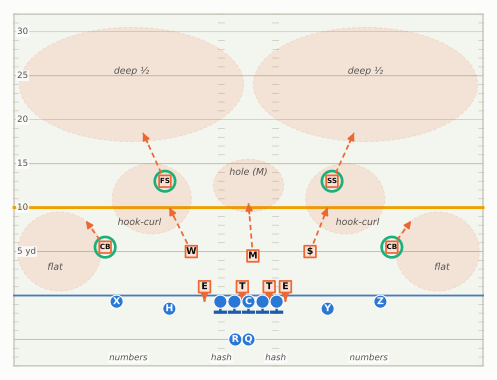
Figure 36.1: Cover 2 against a 2x2 formation (11 personnel, a nickel defense). Before the snap: two safeties 13 yards deep, between the hash and the numbers; both corners 5 or 6 yards off, a step outside the wide receivers. At the snap (dashed arrows) the four linemen rush and seven defenders drop to their landmarks: the safeties to the two deep halves, the corners to the flats, the Will (W) and the nickel ($) to the hook-curl zones on each side, and the Mike (M) to the hole, the defended zone in the middle. Five zones underneath, two deep: that is the whole coverage.

Here is each job, and the reason behind it.

  • The two safeties: a deep half each. Each safety owns everything deep on his side of the field, from the middle of the field to the sideline: about 27 yards of width. His rule, in its simplest form, is nothing gets behind me: as deep as the deepest receiver in his half, as wide as the widest. He reads the inside receiver (#2) first, because #2’s seam is the threat closest to the middle, then the outside one (#1), and breaks on the ball when it’s thrown. He lines up 12 to 14 yards deep, between the hash and the numbers, roughly 8 to 10 yards from the middle of the field, because from there he can reach both ends of his half; by the time the quarterback finishes his drop he has backpedalled to about 18 to 20 yards, near the top of the numbers. A quarters safety (Quarters and the Two-High Match Family) usually stands shallower and closer to the hash, because he has only a quarter of the field; being deeper and wider is the price of owning a half.
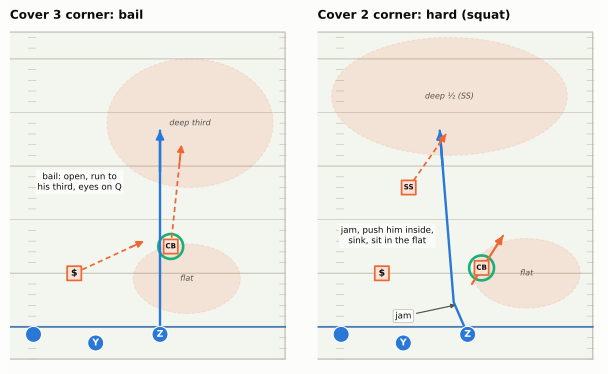
  • The two corners: the flats. A Cover 2 cornerback is not a deep defender at all. He lines up close, outside the wide receiver, and at the snap he jams or redirects him and then stays short, at the top of the flat (6 to 9 yards deep, a little deeper than the 0–6 of the textbook flat, so he can also slow down anything going deep). This is the hard corner, and the next section is about him.
  • The Will and the nickel: the hook-curl zones. Between the flat and the middle, each takes the curl and hook area on his side, 10 to 12 yards deep, under the inside receiver’s routes and in the lane of the outside receiver’s curls and digs. One more job matters a lot: if the slot receiver (#2) runs straight up the seam, the hook-curl defender gets in his way (coaches say he walls him) and rides him to 10 or 12 yards before letting the safety take over. Every step that costs the receiver is a step the safety gains. In a base 4-3 defense these two are the outside linebackers, the Sam and the Will; in nickel, the usual passing-down defense, the nickel back plays the Sam’s part.
  • The Mike: the hole. The middle linebacker drops straight back to the middle of the field, 10 to 12 yards deep, to take away throws over the ball: digs, crossing routes, a tight end sitting down in the middle. (Hold on to this job. Tampa 2 changes it.) A word trap: the hole is the name of this zone, a defended one, from Coverage Fundamentals. When announcers say “a hole in the coverage” they mean the opposite, an empty spot. This chapter calls those empty spots thin spots; the one exception is the name hole shot, which the whole league uses.
  • The four rushers. In a pure Cover 2 nobody else is spare. The coverage depends on four linemen getting to the quarterback without help, because seven defenders are all spoken for.
ImportantWhy it exists

What Cover 2 buys. Five underneath defenders is the most any common zone puts there, so every short throw has a defender within a few yards of it, and the quarterback has to fit the ball into small windows or settle for short gains. The corners in the flats take away the quick throws to the outside that beat off-coverage corners (quick outs, hitches, bubble screens), and they squeeze the outside receivers’ releases, which disrupts the timing of everything else. Two deep safeties mean no single deep defender is ever alone against two vertical routes in the middle of the field, as Cover 3’s lone safety can be. And the corners never have to run step for step with the fastest receivers on the field, which lets a defense survive with corners who are physical and smart rather than fast.

What it gives up. Only two defenders guard the whole deep field, so each safety has a huge area, and wherever two receivers go deep in one half, one safety is in a two-on-one. The corners stay short, so the sideline behind them is empty until a safety gets there. With both safeties deep, only six or seven defenders are near the line of scrimmage against the run (the box), one fewer than when a safety comes down. Cover 2 is a bet that the offense can’t complete enough of the hard throws to make up for all the easy ones it takes away.

Cover 2 also has a run-defense job built into it, and it explains the corners’ alignment as much as the passing game does. Against a run to his side, the Cover 2 corner is the force player: he comes up hard from the outside, meets the ball carrier at the edge and turns him back inside, toward the linebackers. The safety on that side becomes the alley player, filling the gap between the corner and the box. A corner standing five yards off, outside the receiver, with his eyes inside, is in exactly the right spot to force, which is one more reason he stands there.

Count the box against 11 personnel and you see the cost. The offense has six blockers: five linemen and the tight end. A nickel Cover 2 has six defenders in the box: four linemen, the Mike and the Will (the nickel is out over the slot). Six against six leaves no unblocked defender at the line, so the spare men are the two safeties, and they arrive as alley players from 12 or more yards away. A run that gets past the linebackers against Cover 2 tends to go for 8 or 10 yards, not 4. (Run Fits and Box Math builds the run fits and the counting.)

NoteMadden vs. real life

On a video-game play-call screen, Cover 2 looks like one play: pick it and the same seven zones appear every time. On an NFL defense, “Cover 2” is a family with dozens of members. Some teams press the corners and some play them off; some spot-drop and some pattern-match; some play it with three linebackers and some with a nickel or dime; one coach’s safeties line up on the hashes and another’s on the numbers. Many staffs never call it “Cover 2” at all: the numbers on a call sheet are a team’s own dialect. What stays the same is the skeleton, two deep halves and five underneath, with the corners in the flats. That is what to look for.

The hard corner

The single most distinctive player in Cover 2 is the cornerback who doesn’t go deep. A hard corner (also called a squat corner) lines up 5 to 7 yards off the outside receiver, or right on him in press, a step outside him with his shoulders turned slightly in so he can see through the receiver to the quarterback. At the snap he does three things in order:

  1. Collision and redirect. He meets the receiver at the line or as he comes off it, gets his hands on him, and makes him release inside. A receiver who wants to run straight up the sideline gets pushed toward the middle of the field, where the safety is. Every step the receiver loses getting past the corner is a step the safety gains. All of this has to happen within five yards of the line of scrimmage: after that, contact before the ball is thrown is a foul, as long as the quarterback is still in the pocket with the ball.1
  2. Read #2, and sink. Before the snap he looks at #1. At the snap his eyes go to the inside receiver (#2), because #2 is the one who can threaten his flat. If #2 goes straight up the field, or nobody comes toward the flat at all, he doesn’t stand still: he gives ground, backing up and widening under #1, often to 10 or 12 yards, to shrink the gap between himself and the safety. Coaches teach it as a rule: sink until something threatens the flat.
  3. Squat. When #2 (or a running back) breaks toward the flat, or the quarterback’s eyes go there, he stops, plants and comes forward to make the tackle. He keeps outside leverage throughout, so anything that goes inside of him goes to the linebackers and the safety, and nothing escapes to the sideline.

“Squat” does double duty, and it’s worth saying once: a squat corner is the alignment (short and outside), and squatting on a route is step 3. Same idea both times: this corner lives low.

Set that next to the Cover 3 corner from the previous chapter, against the same receiver.

Show the Python
fig, axes = plt.subplots(1, 2, figsize=(6.6, 3.9))
off = offense("gun_2x2")
# Cover 3: off corner bails to a deep third; the nickel is the curl-flat defender
right = [p for p in off if p.key in ("RT", "Y", "Z")]          # only the right side is drawn
c3_def = [p.moved(d=7.5, w=16.0, label="CB") if p.key == "RCB" else p.moved(d=5.0, w=7.0)
          for p in defense("nickel", "single_high", off) if p.key in ("RCB", "NB")]
a = Play(right, c3_def, los=35, to_go=None)
a.route("Z", r.go(19))
a.drop("RCB", (17.0, 17.0), speed=5.5)
a.drop("NB", (8.0, 13.5))
a.zone((19.0, 17.8), (12.0, 15.5), "deep third")
a.zone((4.5, 17.5), (6.5, 10.0), "flat")
a.highlight("RCB")
fa = a.draw(ax=axes[0], lateral=(1.5, HALF), window=(-3, 27.5), title=False)
no_numbers(fa.ax)
say(fa, a, "bail: open, run to\nhis third, eyes on Q", (13.5, 7.5), fs=6.5)
axes[0].set_title("Cover 3 corner: bail", fontsize=9, loc="left")
# Cover 2: hard corner jams, re-routes Z inside, sinks into the flat
b = Play(right, [p for p in c2_shell(off) if p.key in ("RCB", "NB", "SS")], los=35, to_go=None)
b.route("Z", r.path((3.0, -1.3), (19.0, -2.6)))
b.path("RCB", [(4.0, 15.4), (8.5, 18.3)], absolute=True, speed=3.0)
b.drop("SS", (18.0, 13.0))
b.zone((21.5, 13.3), (11.0, 22.0), "deep ½ (SS)")
b.zone((5.0, 20.5), (6.5, 10.0), "flat")
b.highlight("RCB")
fb = b.draw(ax=axes[1], lateral=(1.5, HALF), window=(-3, 27.5), title=False)
no_numbers(fb.ax)
say(fb, b, "jam, push him inside,\nsink, sit in the flat", (8.5, 7.5), fs=6.5)
pointer(fb, b, "jam", (1.0, 9.0), (2.2, 14.6), fs=6.5)
axes[1].set_title("Cover 2 corner: hard (squat)", fontsize=9, loc="left")
fig.tight_layout(w_pad=0.8)
plt.show()
Figure 36.2: Two corners, one receiver (the offense’s right side only). Left, Cover 3: the corner lines up 7 or 8 yards off and bails at the snap, turning to run with Z into his deep third; the flat is the curl-flat defender’s ($). Right, Cover 2: the corner lines up 5 yards off, a step outside Z, jams him, forces his release inside toward the safety, then sinks under him and sits in the flat. Behind him, the strong safety (SS) has the whole deep half. Same receiver, opposite jobs: one corner is a deep defender who also helps in the flat, the other a flat defender who also slows down the deep ball.

Why build a corner this way? Three reasons, and each is about time.

The flats are where quick throws go. A corner 8 yards off and backing up concedes the 5-yard out and the hitch: by the time he plants and drives on the throw, the receiver has caught it and turned upfield. A squat corner is already there. Against offenses that live on quick timing throws to the outside (The Quick Game), that matters on every down.

The jam buys the safety time. The weakness of Cover 2 is the ground the safeties have to cover, so anything that delays the outside receiver helps. A receiver who has been knocked off his line and forced inside arrives at 15 yards a half-second late and closer to the middle, which is exactly where the safety is coming from.

Outside leverage turns the sideline into a defender. Because the corner refuses to let anything escape outside, every receiver on his side is funnelled toward the middle of the field, into the zones of the linebackers and the safety. The offense has to throw into the defense.

The price is plain from the picture: once the receiver is past him, the corner is no longer a deep defender. Everything behind him and outside the safety is grass, and it stays grass until the safety covers the 10 or 15 yards to get there.

Where else you’ll see him. The squat corner is not only a Cover 2 player. Many staffs call any side where the corner takes the flat a cloud side (C for corner) and a side where a safety comes down to the flat a sky side (S for safety): the same words as the Cover 3 rotations, because it’s the same job. The cloud corner in Cover 3 and the Cover 2 side of Cover 6 (Quarters and the Two-High Match Family) are both squat corners. And in today’s NFL the squat often comes after the snap: a corner lines up 7 or 8 yards off, looking like a deep defender, and drives down to the flat once the ball is snapped. Some defenses even flip the jobs, in what coaches call Cover 2 invert: the corners bail to the deep halves and the safeties come down to the flats.

NoteGo deeper: when the rules changed the corner’s job

Until the mid-1970s, defenders could keep chucking a receiver (hitting or shoving him with their hands as he ran his route) all the way down the field until the ball was in the air. The league chipped at that in 1974 and 1977, limiting how many times a defender could jam the same receiver. Pittsburgh’s Mel Blount, a 6-foot-3 cornerback on the Steelers defenses of the 1970s, was so good at manhandling receivers that the bigger 1978 change is still called the “Mel Blount rule”: from that season, defenders could make contact with a receiver only within 5 yards of the line of scrimmage.2 The Cover 2 corner’s jam survived because it happens inside those 5 yards. What disappeared was a defense’s ability to keep rerouting receivers with linebackers and safeties downfield. The full story of the chuck rule and its effect on passing is in 1978 and the Passing Revolution, and today’s contact rules are in Contact Rules and Penalties as Strategy.

Where Cover 2 is thin

Every coverage has thin spots, because seven defenders can’t cover a field 53 yards wide and as deep as a quarterback can throw. Cover 2’s are unusually well known, because the coverage is so old and so common that every offense carries a list of its “Cover 2 beaters.” There are four classic attacks, aimed at three places: two of them, the hole shot and the smash corner, land in the same grass along the sideline, but they get there from different directions and put a different defender in a bind.

Show the Python
off = offense("gun_2x2")
land = {"LCB": (8.0, -18.0), "RCB": (8.0, 18.0), "WILL": (10.0, -9.0), "NB": (10.0, 9.0),
        "MIKE": (10.5, 0.0), "FS": (18.5, -12.0), "SS": (18.5, 12.0)}
dfn = [p.moved(d=land[p.key][0], w=land[p.key][1]) if p.key in land else p for p in c2_shell(off)]
keep = {"LT", "LG", "C", "RG", "RT", "QB", "Y", "Z"}
mp = Play([p.moved(d=-7.5) if p.key == "QB" else p for p in off if p.key in keep], dfn, los=35, to_go=None)
mp.route("Z", r.path((4.0, 0.6), (22.0, 6.2)))                 # go / fade, bending toward the sideline
mp.route("Y", r.path((10.0, 0.0), (19.5, 10.8)))               # corner route from the slot
fld = mp.draw(lateral="full", window=(-9, 31))
no_numbers(fld.ax)
ruler(fld, mp, widths=True)
hole(fld, mp, (21.5, 20.0), (8.0, 9.5), "")
pointer(fld, mp, "① hole shot:\nZ's go route", (27.0, 20.0), (17.0, 19.8), fs=7)
pointer(fld, mp, "② smash corner:\nY's corner route", (15.0, 3.5), (14.5, 14.8), fs=7)
hole(fld, mp, (24.0, 0.0), (8.0, 11.0), "③ deep middle")
hole(fld, mp, (15.0, -19.5), (5.5, 10.0), "④ sideline\nhole")
pointer(fld, mp, "one safety,\n27 yards of width", (28.0, 9.0), (18.5, 12.0), fs=7)
say(fld, mp, "corners sit\nat 8 yards", (4.0, -18.0), fs=6.5)
plt.show()
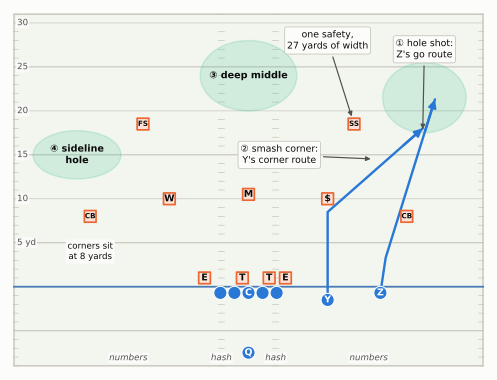
Figure 36.3: The Cover 2 map: the seven defenders at their landmarks about a second and a half after the snap, and the three thin places (green), attacked four ways. On the right, the deep sideline, behind the corner and in front of the safety, reached two ways: (1) the hole shot, Z’s go route straight up the sideline past the squatting corner (it tests the safety’s speed), and (2) the smash corner, Y breaking out to the same grass from inside, over the corner’s head (it tests the corner’s choice). (3) The deep middle, between the two safeties and behind the Mike. (4) On the left, the sideline hole: the intermediate band outside the hook-curl defender, above the corner and below the safety, where deep outs and comebacks land. Every thin place exists on both sides; each is marked once here. The receivers are drawn where they line up.

① The hole shot. The most famous one. The corner is sitting in the flat, 6 to 10 yards deep. The safety is on his half, starting 13 yards deep and 8 to 10 yards from the middle. Between them, along the sideline from about 15 to 25 yards deep, is a strip of grass that nobody is standing on at the snap. A hole shot is a ball thrown into that strip: usually the outside receiver’s go route or a fade (a go route that bends toward the sideline, away from the safety, and is thrown over the receiver’s outside shoulder; it gets its full treatment in the red-zone chapter), released past the squatting corner and thrown on time, before the safety can get across. The arithmetic is a race. From his alignment, the safety is roughly 14 yards from the spot where a fade is caught 20 or 22 yards downfield, 5 yards from the sideline. Opening and gaining depth while he reads, then running at 6 yards a second, he needs close to 3 seconds to get there. The throw leaves the quarterback’s hand a little after 2 seconds and hangs in the air for most of a second, so it lands at about the same moment. And a tie goes to the offense: to break up the pass the safety has to arrive a step before the ball, not with it. So anything that holds him for a beat (a second receiver running up the seam inside him, or the quarterback’s eyes looking that way) turns a tie into a completion. That is why offenses pair the outside go route with a seam inside it: two vertical routes in one half put one safety in a two-on-one. Four verticals does it on both sides at once.

② The smash corner. Smash reaches the same grass from the inside, and it tests a different defender. The outside receiver runs a hitch at 5 or 6 yards, which holds the hard corner in the flat: his rules tell him to sit on it. The inside receiver runs about 10 yards up the field and breaks toward the back corner of the field, over the corner’s head and under the safety. The corner can’t play both: if he sinks under the corner route, the hitch is open; if he squats on the hitch, the corner route is. It is a high-low read of one defender, and the next section plays it out frame by frame.

③ The deep middle. With two safeties each guarding a half, the line where the halves meet is the farthest point from both of them. Nobody is standing in the middle of the field 18 to 25 yards deep, and the Mike, who has the hole at 10 to 12 yards, can’t run with a receiver who goes past him. A seam route that splits the safeties, a post, or a tight end running straight up the middle puts both safeties in a bind: whichever one comes inside to help has left his own sideline. This is the hole Tampa 2 was built to close.

④ The sideline hole. Underneath the safety and above the corner there is also an intermediate gap, about 12 to 18 yards deep, outside the hook-curl defender. A deep out or a comeback from the outside receiver lands there; so does the middle route of a flood concept, which sends one receiver deep to hold the safety and one to the flat to hold the corner, then throws to the one in between. Coaches name these spots differently; some call the whole strip from 12 to 25 yards “the Cover 2 hole” (an empty spot, in the announcers’ sense) and some reserve the term for the deep end. The geometry is the same either way: the corner is low, the safety is high and wide, and the sideline between them is the offense’s.

CautionCommon misconception

“Cover 2 is soft.” It’s an easy thing to believe when a defense gives up 8-yard completions on third-and-12 and the announcer says the defense is “playing soft.” But Cover 2’s corners are the most aggressive in football against short throws, and five underneath defenders make the short middle crowded. What Cover 2 gives up is not the short ball but specific intermediate and deep windows, and a defense that plays it well makes the offense find those windows with a well-timed, accurate throw, over and over. A third-and-12 completion for 8 is the coverage working.

What the data say: quarterbacks throw deep middle against Cover 2

If the deep middle really is the weak spot, quarterbacks should aim there more often against Cover 2 than against other coverages. They do. The charting data in nflverse label the coverage on most dropbacks since 2018, and the play-by-play records whether each pass went to the left, middle or right of the field. (One limit: the labels have no separate code for Tampa 2, so “Cover 2” here and in the charts below is the whole Cover 2 family, Mike-runs-the-middle or not.)

Show the Python (nflverse coverage labels joined to play-by-play, 2018–2025)
from gridiron.data import nfl, pbp

SEASONS = list(range(2018, 2026))
PB_COLS = ["season", "season_type", "game_id", "play_id", "down", "ydstogo", "half_seconds_remaining",
           "qb_dropback", "pass_attempt", "air_yards", "pass_location", "epa"]
_pb = pbp(SEASONS, columns=PB_COLS)
_pb = _pb[_pb["season_type"] == "REG"]
_part = (nfl().load_participation(SEASONS).to_pandas()
         .rename(columns={"nflverse_game_id": "game_id"})[["game_id", "play_id", "defense_coverage_type"]])
CV = _pb.merge(_part, on=["game_id", "play_id"])
# charted dropbacks; blown coverages, 'combo' and prevent left out
CV = CV[(CV["qb_dropback"] == 1) & CV["defense_coverage_type"].notna()
        & ~CV["defense_coverage_type"].isin(["BLOWN", "COMBO", "PREVENT"])].copy()
ERAS = ["2018–2022 (NGS charting)", "2023–2025 (FTN charting)"]
CV["era"] = np.where(CV["season"] <= 2022, ERAS[0], ERAS[1])


def _dd(row):
    if pd.isna(row.down):        # two-point tries have no down (and ydstogo 2): keep them out of 3rd & short
        return "none"
    if row.down == 1:
        return "1st"
    if row.down == 2:
        return "2nd"
    for hi, lab in ((2, "3rd/4th & 1–2"), (6, "3rd/4th & 3–6"), (10, "3rd/4th & 7–10")):
        if row.ydstogo <= hi:
            return lab
    return "3rd/4th & 11+"


CV["dd"] = CV.apply(_dd, axis=1)
CV["c2"] = CV["defense_coverage_type"].eq("COVER_2")
CV["m2"] = CV["defense_coverage_type"].eq("2_MAN")
DEEP = CV[(CV["pass_attempt"] == 1) & (CV["air_yards"] >= 15) & CV["pass_location"].notna()].copy()
DEEP["middle"] = DEEP["pass_location"].eq("middle")
Show the Python
order = ["COVER_1", "COVER_3", "COVER_4", "COVER_2"]
names = {"COVER_1": "Cover 1", "COVER_3": "Cover 3", "COVER_4": "Quarters\n(Cover 4)", "COVER_2": "Cover 2"}
share = (DEEP.groupby(["defense_coverage_type", "era"])["middle"].mean() * 100).unstack().reindex(order)
_g = DEEP[DEEP["middle"]].groupby(["defense_coverage_type", "era"])["epa"]
epa = _g.mean().unstack().reindex(order)
epa_ci = (1.96 * _g.std() / np.sqrt(_g.count())).unstack().reindex(order)
fig, axes = plt.subplots(1, 2, figsize=(6.6, 3.0))
x = np.arange(len(order))
bw = 0.38
for i, e in enumerate(ERAS):
    col = style.SERIES[i]
    for ax, vals, fmt in ((axes[0], share[e], "{:.0f}%"), (axes[1], epa[e], "{:+.2f}")):
        bars = ax.bar(x + (i - 0.5) * bw, vals.values, width=bw * 0.92, color=col, label=e)
        if ax is axes[1]:
            ax.errorbar(x + (i - 0.5) * bw, vals.values, yerr=epa_ci[e].values, fmt="none",
                        ecolor=style.INK_2, elinewidth=0.8, capsize=0, zorder=4)
        for xb, v in zip(x + (i - 0.5) * bw, vals.values):
            if ax is axes[0]:
                ax.text(xb, v + 0.6, fmt.format(v), ha="center", va="bottom", fontsize=6.5, color=style.INK)
            else:                    # inside the bar, so the labels stay clear of the interval lines
                ax.text(xb, 0.03, f"{v:.2f}", ha="center", va="bottom", fontsize=5.8, color="white",
                        rotation=90, fontweight="bold")
for ax, title, ylab in ((axes[0], "Share of deep passes thrown to the middle", "% of passes 15+ yards"),
                        (axes[1], "Value of a deep pass to the middle", "EPA per pass")):
    ax.set_xticks(x)
    ax.set_xticklabels([names[c] for c in order], fontsize=7.5)
    ax.set_title(title, fontsize=8.5)
    ax.set_ylabel(ylab, fontsize=7.5)
    ax.tick_params(labelsize=7)
    ax.grid(axis="x", visible=False)
axes[0].set_ylim(0, 45)
axes[1].set_ylim(0, 1.2)
fig.legend(handles=[Patch(color=style.SERIES[0], label=ERAS[0]), Patch(color=style.SERIES[1], label=ERAS[1])],
           loc="upper center", ncol=2, fontsize=7.2, frameon=False, bbox_to_anchor=(0.5, 1.02))
fig.tight_layout(w_pad=1.5, rect=(0, 0, 1, 0.92))
plt.show()
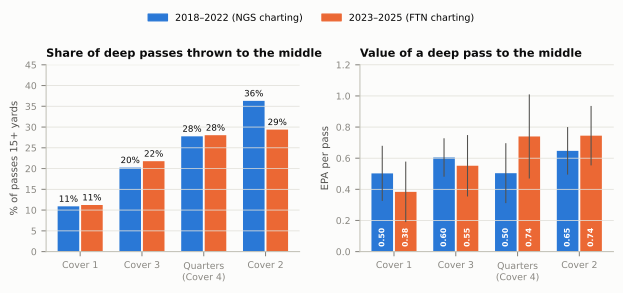
Figure 36.4: Where deep passes go against each coverage. Left: of all passes thrown 15 or more yards past the line of scrimmage, the share the play-by-play records as thrown to the middle of the field (rather than left or right). Right: expected points added (EPA) per deep pass to the middle, with 95% intervals (thin lines). Against Cover 1 and Cover 3 a deep safety sits in the middle, and quarterbacks rarely throw there; against Cover 2 they throw there about one time in three, the most of these four in the Next Gen Stats seasons and level with quarters in the FTN seasons. The value of those throws is noisier: Cover 2 is at the top of the right panel, level with quarters in the FTN seasons, but the intervals overlap, so read it as ‘at least as valuable as anywhere else’, not ‘clearly the most’. Regular-season dropbacks with a charted coverage; the two charting sources are shown separately because they label coverages differently.

The pattern is the coverage’s geometry showing through the numbers. Against Cover 1, with a free safety parked in the middle, only about one deep pass in nine goes there. Against Cover 3 it is about one in five. Against Cover 2 it is about one in three in the Next Gen Stats seasons and a little under that in the FTN seasons, as high as against any coverage. A deep pass to the middle against Cover 2 has been worth about two-thirds to three-quarters of a point to the offense on average, at least as much as the same throw against Cover 1 or Cover 3, though with 500 to 800 such throws per charting era the gaps are inside the noise.3 Quarters, the other two-high family, is close behind or level on how often the middle is targeted, and in the FTN seasons a deep throw to the middle against it has been just as valuable; its safeties play narrower and help in the middle, which is part of why (that’s the next chapter).

Two cautions. The play-by-play’s “middle” is a scorer’s judgement, not a measured zone, so read the shares as rough. And these are results, which mix the coverage’s weakness with the offense’s choices: offenses that expect Cover 2 call plays that attack the middle. That is the point, though. The middle is where offenses go when they see two deep safeties, which is why defenses started looking for someone to put there.

Smash against Cover 2, move by move

Dropback Concepts drew smash from the quarterback’s side, as a read. Here it is from the defense’s side, as a problem with a clock on it. Watch the right cornerback.

Show the Python
def smash_play():
    off = offense("gun_2x2")
    p = Play(off, c2_shell(off, corner_d=5.5), los=40, to_go=8)
    protect(p)
    p.dropback(2.0)
    p.route("Z", r.hitch(6.0))
    p.route("Y", r.path((10.0, 0.0), (20.0, 11.5)))
    p.route("X", r.hitch(6.0))
    p.route("H", r.path((19.0, 0.0)))                  # seam: holds the free safety on the other side
    p.route("RB", r.flat(1.5, 5.0), side=-1)
    p.pass_to("Y", t=1.85)
    # right corner: collision, sink a little, then drive on the hitch he sees in front of him
    p.drop("RCB", (5.8, 16.0), speed=1.2)
    p.drop("RCB", (7.6, 17.3), speed=2.4)
    p.path("RCB", [(6.4, 15.2)], absolute=True, speed=3.5)
    # strong safety: stays on top of Y's stem, breaks a beat after the ball is in the air
    p.drop("SS", (18.8, 12.3), speed=4.0)
    p.path("SS", [(17.8, 18.0)], absolute=True, speed=5.2, delay=0.75)
    p.drop("NB", (10.0, 9.5)); p.drop("MIKE", (10.5, 0.0)); p.drop("WILL", (9.5, -6.8))
    p.drop("LCB", (7.6, -17.3)); p.drop("FS", (18.8, -12.3))
    p.highlight("RCB")
    return p


smash = smash_play()
SMASH_T = [0.0, 0.9, 1.9, 3.7]
if PDF:
    strip(smash, SMASH_T, ["Snap · corner 5 yards off, outside Z", "+0.9 s · jam, Z turns for the hitch",
                           "+1.9 s · Y breaks to the corner: throw", "+3.7 s · over the corner, under the safety"],
          lateral=(-19.5, HALF), window=(-8.0, 23.5), ruler_side="right",
          notes_at={1: [("hitch", (3.0, 18.2))], 3: [("corner\nroute", (21.8, 21.0))]})
    plt.show()
else:
    show_animation(smash, times=SMASH_T)
Figure 36.5: Smash against Cover 2, the offense’s right side, simulated. Snap: the corner (ringed) is 5 or 6 yards off Z, a step outside him; the strong safety (SS) is 13 deep. +0.9 s: Z has pushed to 6 yards and is turning back for the hitch; the corner, doing his job, has jammed and is sitting in the flat. Y, the slot receiver, is running straight up the field past the nickel ($). +1.9 s: Y has broken toward the sideline at about 10 yards and the quarterback throws. The corner is driving on the hitch; the safety has backed up to 19 yards, on top of Y but 8 yards inside the spot Y is heading for, and is only now reacting. +3.7 s: the ball arrives about 18 yards downfield and 6 or 7 yards from the sideline, over the corner and under the safety, who is still a couple of steps away. On the left, X runs a hitch and H a seam, to keep the free safety (FS) busy on his own side.

Look at the corner across the panels and you see a player doing everything right and losing anyway. His rules say: jam the outside receiver, sink, and squat on anything short in the flat. The hitch is short and in the flat, so he squats on it. Meanwhile, the corner route breaks behind him into the strip of grass he just left. The safety’s rules say: stay deeper than anything in your half. He does: at 1.9 seconds he is 19 yards deep, deeper than Y, but 8 yards inside the spot the corner route is heading for, and he can’t start running at it until he’s sure that’s where the ball is going. By the time he is sure, the ball is in the air. The throw beats him by a step.

That is the general shape of beating any zone: find one defender with two jobs and make him choose. In smash the cornerback is that defender. And the quarterback’s read is mercifully simple: he watches only the corner. Corner sinks, throw the hitch. Corner squats, throw the corner route.

How does the defense fight back? Not by playing Cover 2 harder, but by changing what the corner and safety do when they see this route combination.

  • Wall the slot. Watch the nickel ($) in the figure: Y runs straight past him untouched. His rules say he should have got in Y’s way as Y released up the field and ridden him for a few yards. A collision at 6 yards delays the corner route by a beat, and a beat is all the safety needs. What the nickel can’t do is follow Y toward the sideline: that would empty the hook-curl zone behind him for the next route.
  • Teach the corner to sink further. This is the corner’s #2 key from the last section. When #2 goes vertical and #1 runs something short, many Cover 2 coaches tell the corner to keep sinking under the vertical instead of jumping the hitch: give up the 6-yard hitch, which the hook-curl defender can rally to, and take away the 18-yard corner route.
  • Widen the safety. A safety who aligns wider, or who reads the inside receiver’s release and goes straight to the corner route, gets there sooner, at the cost of the seam and the deep middle.
  • Change the coverage to that side. Against a team that loves smash, a defense can play Cover 2 to one side and quarters to the other (Cover 6), or play Palms (also called 2-Read), where the corner lines up off and stays on the outside receiver while the safety reads the slot and takes him when he goes vertical: the corner route runs into the safety and the hitch runs into the corner. Both are in Quarters and the Two-High Match Family. Or it can play 2-Man, where the corner ignores the zones and follows his man, and the corner route runs into a trailing slot defender and a safety over the top.

Smash also shows why play-calling is a guessing game. Smash is a great call against Cover 2 and a mediocre one against Cover 3, whose corners drop deep into the corner route’s path. Which is why defenses that play a lot of Cover 2 try hard to make it look like something else before the snap (Disguise, Rotation, and Split-Field Coverage), and why What Beats What puts smash versus Cover 2 in the first row of its matrix.

Tampa 2: the Mike takes the middle

Go back to thin spot ③, the deep middle. Cover 2 has nobody there, and offenses learned to send a receiver straight up it: a tight end, a slot receiver, a running back out of the backfield. The Mike, sitting in the hole at 10 to 12 yards, watches him run past. Each safety is busy with his own half. The ball goes over the Mike and between the safeties.

Tampa 2 answers that with one change. At the snap, if it’s a pass, the Mike doesn’t stop at 10 yards. He opens (usually toward the side with more receivers), reads the quarterback’s eyes and whichever inside receiver goes vertical, and runs down the middle of the field to 15 or 20 yards. He stays on top of and inside that receiver and carries him, and he bumps anything crossing his path on the way. Coaches call his landing spot the “pipe” or the “middle of the field”: the space between the two deep safeties. Everything else is Cover 2: two safeties on the deep halves, squat corners in the flats, two outside linebackers (or a linebacker and the nickel) in the hook-curl zones.

How does he know it’s a pass in time? The same way every linebacker does: he reads the offensive linemen in front of him. Linemen who stand up and step back into pass protection (“high hats,” in coaching shorthand) mean pass; linemen firing forward mean run. He has to make that call in his first step.

Show the Python
def tampa_play():
    off = offense("gun_2x2")
    p = Play(off, c2_shell(off), los=40, to_go=10)
    protect(p)
    p.dropback(2.5)
    p.route("X", r.go(19)); p.route("Z", r.go(19))
    p.route("Y", r.path((10.0, 0.0), (20.0, -4.5)))
    p.route("H", r.curl(11.0))
    p.route("RB", r.path((3.0, 4.0), (6.5, 12.5)), side=-1)
    p.pass_to("RB", t=2.55)
    # Mike: open and run the middle, carrying the seam
    p.path("MIKE", [(9.0, 1.2), (16.0, 3.0), (19.5, 3.0)], absolute=True, speed=5.9, delay=0.15)
    # corners: collision, sink under the outside receivers; the left corner comes up on the flat throw
    p.drop("LCB", (6.0, -15.8), speed=1.3)
    p.drop("LCB", (9.5, -16.8), speed=2.8)
    p.path("LCB", [(2.9, -14.7)], absolute=True, speed=5.5, delay=0.15)
    p.drop("RCB", (6.0, 15.8), speed=1.3)
    p.drop("RCB", (9.5, 16.8), speed=2.8)
    # safeties widen over the outside verticals; underneath droppers to the hook-curl zones
    p.drop("FS", (22.5, -14.5), speed=4.8); p.drop("SS", (22.5, 14.0), speed=4.8)
    p.drop("WILL", (9.5, -10.0)); p.drop("NB", (9.5, 10.0))
    p.highlight("MIKE")
    return p


tampa = tampa_play()
TAMPA_T = [0.0, 1.0, 2.0, 3.4]
if PDF:
    strip(tampa, TAMPA_T, ["Snap · it looks like Cover 2", "+1.0 s · the Mike turns and runs",
                           "+2.0 s · the seam runs into him", "+3.4 s · checkdown; the corner rallies"],
          lateral=(-20.5, 20.5), window=(-8.5, 25.5),
          notes_at={2: [("Mike carries\nthe seam", (16.0, -4.5))]},
          extras={3: lambda f: hole(f, tampa, (12.5, -3.0), (5.0, 8.0), "empty now:\na dig sits here", fs=6.0)})
    plt.show()
else:
    show_animation(tampa, times=TAMPA_T)
Figure 36.6: Tampa 2 against a seam, simulated. Snap: a Cover 2 picture, Mike (M, ringed) 4.5 yards off the ball. +1.0 s: it’s a pass, so he turns and runs down the middle. The corners have jammed X and Z and sunk; the safeties are widening over them. +2.0 s: Y, the slot receiver, has bent his seam toward the middle, the throw Cover 2 hates, and runs into the Mike, now about 15 yards deep and still running, with the strong safety over the top. +3.4 s: nothing is open deep, so the quarterback checks the ball down to the running back in the left flat, and the left corner, who was sitting at the top of the flat, comes up to meet him. The green patch is the price: the middle at 10 to 15 yards, where the Mike used to be, is now empty, and a dig timed to sit there would be open. Five underneath at the snap; a second later, four underneath and three deep: that is the Tampa 2 bargain.

Look at the third panel and count the deep defenders: two safeties and the Mike. A coverage that started as two-high has become, by the time the seam gets to 15 yards, a three-deep coverage. The safeties are free to play wider, because the middle is covered, which also shrinks the thin spot along the sideline. Now do the arithmetic, because it is the whole point. At the snap there are five underneath defenders, as in any Cover 2, so the quick game still runs into a crowd. About a second later the Mike has run past the short routes, and the coverage is four underneath and three deep. Tampa 2 gives up its fifth underneath defender only once the throws he was there to stop have mostly come and gone.

What does it give up? The Mike’s departure opens a new thin spot of its own: the middle of the field at about 10 to 15 yards, in front of the running Mike and behind the hook-curl defenders (the green patch in the last panel). A dig or a curl by the inside receiver, timed to sit down where the Mike was, is the classic Tampa 2 answer, and offenses have named concepts built for it: dagger sends the slot up the seam to drag the Mike deep and throws a deep dig behind him, and levels and drive stack two in-breaking routes at two depths under him (Dropback Concepts). The Mike also has to make a decision on every snap: run, or stop because it’s a run play, a screen, or a draw. A Mike who runs on a draw has left the middle of the field to the ball carrier.

ImportantWhy it exists: Tampa 2

What it solves. Cover 2’s worst thin spot, the deep middle, without moving a safety. It keeps five defenders underneath against the quick game and gives one up only once the Mike has run past the short routes. It also turns a two-high picture into a three-deep coverage after the snap, so the quarterback who saw “middle of the field open” and decided to throw the seam finds it closed.

What it gives up. The intermediate middle behind the hook-curl defenders, and a lot of the Mike. He has to read run or pass instantly, then run 15 to 20 yards with a tight end or a slot receiver: a linebacker’s job and a safety’s job in one body.

Cover 2 against trips

Everything so far has been against two receivers on each side. Put three on one side (trips, or 3x1) and plain Cover 2’s rules leave a gap. On the trips side, the corner sits on #1’s flat, the nickel walls #2, and the safety has a whole half with three receivers in it. If #3, the innermost, runs straight up the middle, he is past the Mike at 12 yards and in the deep middle with nobody near him. Meanwhile, on the other side, the backside safety has a half with only one receiver in it, X, and the backside corner is already sitting short on X’s side.

Cover 2 teams don’t just accept that. Against 3x1 they adjust, and the common answers are:

  • Bring the backside safety’s eyes inside. He has only X, and the corner is already on X’s side, so he is told to help on #3 going up the middle and leave X to the corner and the sideline.
  • Give #3 to the Mike. This is the Tampa 2 rule exactly: the Mike carries #3 vertical up the pipe. Trips is the formation where the Tampa Mike earns his money.
  • Get out of Cover 2. Many defenses simply check to a different coverage against trips, one built for three receivers on a side; those 3x1 checks are in Disguise, Rotation, and Split-Field Coverage.

Which answer a team uses is a big part of its identity, and the offense’s game plan is often built around finding out.

Why it existed: a defense for fast, smart, ordinary-sized players

The coverage didn’t come first. The players and the philosophy did.

Its roots are in Pittsburgh. Bud Carson, the Steelers’ defensive backs coach from 1972 and their defensive coordinator from 1973 to 1977, had started building a two-deep zone at Georgia Tech, and in Pittsburgh he refined it into the coverage behind the “Steel Curtain,” the nickname of the Steelers’ 1970s defense (and especially its four-man line). Its signature was a middle linebacker who dropped into coverage: when the Steelers got Jack Lambert, a rangy, fast middle linebacker, in 1974, Carson could ask him to run deep down the middle. The 1976 Steelers allowed 28 points in total during a nine-game winning streak at the end of the season.4 One of the safeties on the 1977 and 1978 Steelers was an undrafted rookie from Minnesota named Tony Dungy. After a season with the 49ers and a year coaching defensive backs at his old college, he returned to Pittsburgh as an assistant in the early 1980s and was its defensive coordinator from 1984 to 1988.5 Years later he described his whole approach in one sentence: “My philosophy is really out of the 1975 Pittsburgh Steelers playbook.”6

When Dungy became the Tampa Bay Buccaneers’ head coach in 1996, he brought that playbook and a defensive coordinator, Monte Kiffin, who had been on Dennis Green’s Minnesota Vikings staff with him in the early 1990s. Kiffin coordinated Tampa Bay’s defense for thirteen seasons, 1996 to 2008, and the two of them turned the old Steelers idea into an identity, so tightly linked to the franchise that the coverage took the city’s name.7

Their version was built on a few stubborn ideas:

  • Simplicity. A small number of calls, practised until every player could play them without thinking. Players who aren’t thinking play fast.
  • Speed over size. Lighter, faster players at every level: a quick, penetrating 3-technique defensive tackle (Warren Sapp) who penetrated rather than held his ground, linebackers who could run like safeties, and a 4-3 front in which every lineman attacked one gap (Even Fronts).
  • Four rushers, seven in coverage. No exotic blitzes. The four-man rush was expected to get home on its own, which is why the scheme prized pass-rushing linemen: if four can’t win, seven defenders can’t cover forever.
  • Everything in front, then tackle. Spot-drop zones, every underneath defender’s eyes on the quarterback, and a sprint to the ball the moment it’s thrown. Let the offense complete short passes, tackle immediately, and wait: a 12-play drive has a dozen chances for a penalty, a sack, a dropped pass or a turnover.

The Mike’s deep drop fits all four. It needs a fast linebacker rather than an extra safety, it uses no extra rusher, and it removes the one throw that turns a long drive into a short one.

NoteMadden vs. real life

In a video game you can call Tampa 2 with any eleven players and the Mike will run his drop. On a real field the coverage is only as good as the man running down the middle. Tampa 2 Mikes have to diagnose run or pass in a step, then turn and run 15 to 20 yards with a receiver while reading the quarterback. The players who made it famous were unusual athletes: Chicago’s Brian Urlacher, for example, had played a hybrid linebacker-safety position in college at New Mexico.8 A Tampa 2 with an ordinary middle linebacker is a Cover 2 with an extra hole.

Film room

NoteFilm room: Pittsburgh Steelers 1974–1977 — Bud Carson’s two-deep zone

The Steelers won Super Bowls IX and X (the 1974 and 1975 seasons) with a defense that could play a two-deep zone with squeezing, physical corners and a middle linebacker who dropped into coverage. Jack Lambert, a rookie in 1974, was the prototype of the coverage linebacker; Mel Blount, the cornerback whose physical style later produced the 1978 contact rule, was the prototype of the corner who controlled a receiver’s release. In 1976 the defense was at its peak: during a nine-game winning streak to finish the season it allowed 28 points in total.

What to notice (on NFL Films footage of the era): the corners’ alignment, tight and outside, and how often the middle linebacker turns and runs down the middle of the field on passing plays. The defense is two-deep before the snap and, on those snaps, has a third player deep a second later. Carson’s Steelers mixed this with plenty of other coverages, but twenty years before it had a name, this is the seed of what became Tampa 2.

NoteFilm room: Tampa Bay Buccaneers 2002 — the scheme at its peak

The 2002 Buccaneers were coached by Jon Gruden, who replaced the fired Dungy before the season, but the defense was still Kiffin’s and still Dungy’s design. It led the NFL in fewest points allowed (196, 12.3 a game) and fewest yards allowed, and opponents had a 48.4 passer rating against it (passer rating is the league’s old one-number grade for passing efficiency; the league-wide figure that season was about 80). Derrick Brooks, the weak-side linebacker, was the AP Defensive Player of the Year and returned three interceptions for touchdowns in the regular season.9 In Super Bowl XXXVII, on January 26, 2003, Tampa Bay beat an Oakland offense led by the league MVP, Rich Gannon, 48–21. Gannon threw five interceptions, a Super Bowl record; three were returned for touchdowns (two by Dwight Smith, one by Brooks), and safety Dexter Jackson, with two interceptions, was the game’s MVP.10

What to notice: every underneath defender’s head. At the snap they turn to the quarterback, not to a receiver, and the instant he throws, all of them break toward the ball. Watch Brooks: he plays the hook-curl zone on his side and arrives at the ball at the same moment as the receiver. And watch the Mike (Shelton Quarles that year) run down the middle on passing downs, so that the seam throw the Raiders wanted was never there. Four of Tampa Bay’s starters from that defense, Sapp, Brooks, safety John Lynch and cornerback Ronde Barber, are in the Pro Football Hall of Fame.

NoteFilm room: Colts and Bears, 2006 season — one family, two head coaches, one Super Bowl

Super Bowl XLI, February 4, 2007, in the rain in Miami, was a Tampa 2 family reunion. Indianapolis was coached by Dungy, who had built the same defense there after Tampa Bay; Chicago by Lovie Smith, Dungy’s linebackers coach in Tampa from 1996 to 2000. They were the first two Black head coaches to reach a Super Bowl, and Dungy became the first to win one, 29–17.

The two defenses show how far one scheme can stretch. Chicago’s, coordinated by Ron Rivera and built around Brian Urlacher in the middle, was one of the best in the league: the Bears went 13–3, and the year before Urlacher had been the Defensive Player of the Year and the defense had allowed the fewest points in the NFL.11 Indianapolis’s, coordinated by Ron Meeks, was small and fast and, in the regular season, the worst run defense in the league, allowing 173 rushing yards a game: the light-box cost of a two-deep defense, paid in full. Then strong safety Bob Sanders, who had missed most of the season injured, came back for the playoffs. Sanders was a hard hitter who played close to the line, in effect an extra run defender in or near the box, and with him the Colts allowed about 73 rushing yards a game in the playoffs.12 In the Super Bowl he forced a fumble and intercepted a pass, and cornerback Kelvin Hayden returned an interception 56 yards for a fourth-quarter touchdown.

What to notice: in Chicago’s defense, Urlacher’s depth on passing downs: he routinely ends up 15 or more yards deep in the middle of the field. In Indianapolis’s, the corners: short, outside, and quick to the flat, with Dwight Freeney and Robert Mathis rushing from the ends. And watch the Colts’ offense against Chicago’s two deep safeties, because it is the best lesson in how to play against this family: patience. Indianapolis mostly took what was in front of it. Dominic Rhodes ran for 113 yards into the light box, Joseph Addai ran for 77 and caught 10 passes, and Peyton Manning completed 25 of 38 for 247 yards, a modest 6.5 a throw for the league’s most dangerous passer.13 Cover 2 bets that you won’t complete enough hard throws; the Colts declined the bet.

2-Man: two deep, man underneath

Keep the two deep safeties, but change what the five underneath defenders do. Instead of dropping to zones, each one takes a receiver, man-to-man. That’s 2-Man, called Cover 5 in many playbooks and “Cover 2 Man” in video games and on many broadcasts. Don’t look for logic in the 5: unlike Cover 1, 2 and 3, it doesn’t count deep defenders. It is simply the number many systems gave this call, and some systems use 5 for something else entirely.

Show the Python
off = offense("gun_2x2")
mv = {"LCB": (1.5, -13.4), "RCB": (1.5, 13.4), "NB": (1.8, -7.5), "WILL": (4.5, 7.6), "MIKE": (4.5, -0.8)}
dfn = [p.moved(d=mv[p.key][0], w=mv[p.key][1]) if p.key in mv else p for p in c2_shell(off)]
m2 = Play(off, dfn, los=35, to_go=8)
protect(m2)
for k, t in (("LCB", "X"), ("RCB", "Z"), ("NB", "H"), ("WILL", "Y"), ("MIKE", "RB")):
    m2.man(k, t)
m2.drop("FS", (18.5, -12.0)); m2.drop("SS", (18.5, 12.0))
m2.zone((24.0, -13.3), (13.0, 25.5), "deep ½")
m2.zone((24.0, 13.3), (13.0, 25.5), "deep ½")
m2.highlight("LCB", "RCB", "NB", "WILL", "MIKE")
fld = m2.draw(lateral="full", window=(-8, 32))
no_numbers(fld.ax)
ruler(fld, m2, widths=True)
pointer(fld, m2, "inside shoulder:\ntake away the inside,\nhelp is over the top", (10.5, -17.5), (1.5, -13.4), fs=7)
say(fld, m2, "man underneath, trail technique", (10.5, 3.5), fs=7)
plt.show()
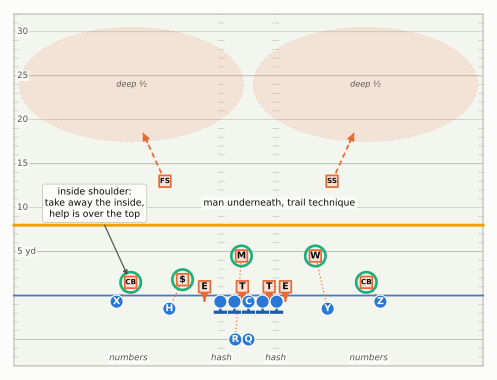
Figure 36.7: 2-Man against a 2x2 formation. The safeties play exactly as in Cover 2, a deep half each. Underneath, five defenders play man (dotted lines): the corners on X and Z, the nickel ($) on the slot receiver H, the Will on the tight end Y and the Mike on the running back. (In man coverage the matchups decide where people line up, so the nickel and the Will have swapped sides from the Cover 2 figure: the defensive back takes the wide receiver, the linebacker the tight end.) The man defenders line up on the receiver’s inside shoulder (inside leverage), because the safety over the top has everything deep and outside; their job is to take away anything short and inside and to trail anything deep. Four rush.

The logic of 2-Man is a cleaner, more aggressive version of the logic of Cover 2. Each man defender knows that anything deep belongs to the safety over the top, so he can play underneath and inside his receiver, in trail technique: a step behind him, on his hip, ready to undercut any route that breaks inside or stops short. The receiver’s only open space is deep, and deep is where the safety is waiting. In effect every outside receiver is in a bracket: the man defender underneath, the safety on top.

When it’s called. 2-Man is a long-yardage and end-of-half coverage. On third-and-8 the offense has to throw past the line to gain, and it knows where: receivers run to 8 or 9 yards and sit down in the seams between zone defenders, right at the sticks. Against Cover 2 zone, a hook-curl defender may be 3 yards away when that ball arrives, close enough to tackle but not to stop the first down. In 2-Man the receiver at 8 yards has a defender on his hip, so he has to be beaten, not just found. 2-Man contests every short and medium throw with a defender on the receiver’s hip and still keeps two players deep, so the offense can’t throw over the top. The charting data show it:

Show the Python
dd_order = ["1st", "2nd", "3rd/4th & 1–2", "3rd/4th & 3–6", "3rd/4th & 7–10", "3rd/4th & 11+"]
ticks = ["1st", "2nd", "3rd/4th\n& 1–2", "& 3–6", "& 7–10", "& 11+"]
fig, axes = plt.subplots(1, 2, figsize=(6.6, 3.1))
xs = np.arange(len(dd_order))
for ax, col, title, top in ((axes[0], "c2", "Cover 2", 30), (axes[1], "m2", "2-Man (Cover 5)", 12)):
    tab = (CV.groupby(["dd", "era"])[col].mean() * 100).unstack().reindex(dd_order)
    for i, e in enumerate(ERAS):
        ax.plot(xs, tab[e].values, marker="o", ms=4.5, lw=1.8, color=style.SERIES[i], label=e)
    ax.set_xticks(xs)
    ax.set_xticklabels(ticks, fontsize=7)
    ax.set_ylim(0, top)
    ax.set_title(title, fontsize=9)
    ax.set_ylabel("% of charted dropbacks", fontsize=7.5)
    ax.tick_params(labelsize=7)
axes[1].legend(fontsize=6.8, loc="upper left", frameon=False)
fig.tight_layout(w_pad=1.5)
plt.show()
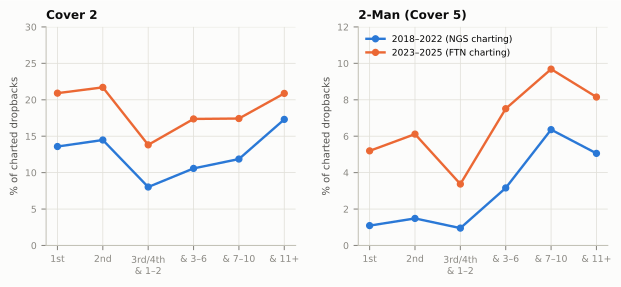
Figure 36.8: When NFL defenses call Cover 2 and 2-Man, by down and distance (share of charted regular-season dropbacks). Left, Cover 2 (zone): fairly steady on early downs and third-and-long, least common on third-and-short, where the offense needs only a yard or two and squat corners and deep safeties are the wrong tools. Right, 2-Man: rare on early downs and peaking on third-and-7 or more, where the defense must cover the receivers at the sticks and keep two safeties deep. The charting source changed after 2022 and FTN labels both coverages more often than Next Gen Stats did, so compare the shapes, not the levels.

In both charting eras, 2-Man is called on third-and-7 to 10 far more often than on first down (about 6 percent of charted dropbacks against about 1 in the Next Gen Stats seasons, and about 10 against 5 in the FTN seasons), and it rises again in the last two minutes of a half, when the offense has to move quickly and the defense can’t afford a long completion.14 It remains a specialist’s call: a few percent of all dropbacks. Cover 2 itself is a far bigger part of the menu, though how big depends on who is charting: about one dropback in seven by Next Gen Stats’ own count (13.9 percent in 2025), closer to one in five in the FTN labels in nflverse (23 percent in 2025), because the two charters draw the line between Cover 2 and its cousins differently. Either way it is least common on third-and-short, where an offense that needs two yards would love to face a defense with corners in the flats and two safeties 13 yards away.15

What 2-Man gives up. Everything man coverage gives up, plus the things two-deep gives up.

  • The quarterback’s legs. Five defenders have their backs turned to the quarterback, chasing receivers, and only four are rushing. If the pocket opens, there is nobody watching the quarterback, and a scramble up the middle can go for 15 yards. The usual counter uses the one defender who may be free: the man assigned to the running back. If the back stays in to block, that defender either rushes too (a “hug” or “green-dog” rule, from Man Coverage) or sits and mirrors the quarterback as a spy. Even so, 2-Man against a running quarterback is a risk every coordinator weighs.
  • The man-beaters. Rub routes and crossing routes like mesh make trailing defenders run through traffic, and routes that break outside (an out, a corner, a fade) go away from the defenders’ inside leverage (Man Coverage has the list).
  • The run. Two safeties deep and five defenders turned to their men: a draw on third-and-8 is a classic call against it.

Telling Cover 2 from 2-Man. Before the snap you can sometimes get a lean: corners pressed tight on the receivers’ inside shoulders, eyes on the receivers, on third-and-long, lean 2-Man; corners 5 yards off and a step outside, lean Cover 2. But it’s only a lean. Defenses know the tell, and plenty of 2-Man is played from the Cover 2 alignment, with corners off and outside until the snap. The answer comes after the snap, in the first second, and the cue is hips and eyes. A zone corner stays square or opens toward the quarterback, his eyes on the ball, while the receiver runs past him. A man corner turns his hips and runs with the receiver, on his inside hip, eyes on the receiver and back half-turned to the quarterback. (Depth alone can fool you: a Cover 2 corner who sinks because nobody threatens his flat can still be near the receiver at 12 yards, but he’ll be looking at the quarterback.)

Why classic Tampa 2 faded, and what survived

In 2005 the Buccaneers had the NFL’s best total defense and the Bears the second-best.16 By 2006 a long list of teams (Buffalo, Minnesota, Kansas City, Detroit and others) had imported the system, often by hiring coaches from Dungy’s and Kiffin’s staffs. A decade later almost none of them played it as a base defense. What happened?

The rules leaned against it. The coverage depended on squeezing receivers’ releases and on underneath defenders who could disrupt routes as they crossed their zones. After the 2003 AFC Championship Game, in which New England’s physical defensive backs (Ty Law above all) took apart Peyton Manning’s Colts, the league made downfield contact past 5 yards a “point of emphasis” for the 2004 season (a rule the league tells officials to enforce more strictly that year), and the flags for illegal contact more than doubled, from 79 in 2003 to 191 in 2004.17 Physical zone coverage became expensive. (There’s an irony in it: the Colts’ complaints drove the change, and Dungy was the Colts’ head coach.) Dynasties and Counterpunches tells the story of that rule and the passing boom that followed.

Offenses learned to live in the seam. A Tampa 2 Mike carrying a tight end up the middle was a fair fight in 1999. Against a 6-foot-6 tight end who ran like a receiver, or a slot receiver lined up as the inside man in a trips formation, it wasn’t. Offenses also learned to attack the hole the Mike vacates, with digs and curls that sit down 12 to 15 yards deep in front of him, and to flood the sideline holes the squat corners leave. Peyton Manning, who practised against Dungy’s Tampa 2 every day in Indianapolis, became one of the best at taking it apart (that, too, is in Dynasties and Counterpunches).

The Mikes were rare. A middle linebacker who can stop the run between the tackles and also run 20 yards with a receiver is one of the rarest athletes in the sport. Teams that copied the scheme without one found out quickly what Cover 2 without a deep middle defender looks like.

Light boxes met better run games. A two-deep, four-rush defense lives with six or seven defenders near the line. That was survivable when offenses lined up in two-back formations and ran into the teeth of it; it was less survivable against spread formations that thinned the box further and against run games designed to exploit it.

Then the league went one-high, and then two-high again, but differently. Through the early 2010s the fashionable answer to everything was Pete Carroll’s Seattle Cover 3, a single-high defense with press corners and an eighth defender near the line (The Cover 3 Family). (Gus Bradley, Seattle’s defensive coordinator from 2009 to 2012, had coached linebackers under Kiffin in Tampa.) When two-high defense came back after 2018, it came back as quarters and match coverage: two safeties who read the receivers in front of them and fit the run, not two safeties guarding halves while the Mike runs the middle (Quarters and the Two-High Match Family).

What survived

A great deal, just not under its old name.

  • Cover 2 itself. It never left. Next Gen Stats counted 13.9 percent of 2025 dropbacks as Cover 2 (the source is in the note on 2-Man’s situations), and the FTN charting in nflverse labels even more; it remains a standard call on long yardage, at the end of halves, and as a change-up for defenses whose base is something else.
  • The Mike who carries the seam. “The middle defender carries #3 vertical” (if the third receiver from the sideline runs straight up the field, the middle linebacker runs with him) is now a rule in Cover 3 match and quarters, the descendants of spot-drop zone. Any time you see a linebacker turn and run with a tight end up the middle of the field in a modern zone, that’s the Tampa 2 Mike’s job inside a newer coverage (Cover 3 match).
  • Two-high pictures that become three-deep. The Tampa 2’s real trick was showing two deep safeties and playing with three deep defenders after the snap. Modern defenses do the same thing by rotating a safety instead of running the Mike, and that is the whole subject of Disguise, Rotation, and Split-Field Coverage.
  • Cover 2 as half a coverage. Cover 6 plays quarters to one side and Cover 2 to the other, squat corner and all; split-field defenses use the Cover 2 half to the short side of the field or against a formation’s lone receiver (Quarters and the Two-High Match Family).
  • 2-Man on third down, as the chart above shows.
  • The people. The Tampa staffs of 1996–2008 seeded a generation of NFL coaches. Lovie Smith and Rod Marinelli took the system to Chicago and Detroit; Mike Tomlin, Tampa Bay’s defensive backs coach from 2001 to 2005, and Raheem Morris, who worked his way up the same secondary, became head coaches.18 The approach (simple calls, fast players, eyes on the quarterback, rally to the ball) outlived the coverage, and a branch of the tree, Matt Eberflus, ran some of the most Cover 2-heavy defenses of the charting era in Indianapolis and Chicago.19
TipWatch for it on Sunday: the squat-corner spotter

On every passing down for one quarter, look at the cornerbacks first.

  • Before the snap. Corners 5 to 7 yards off, a step outside the wide receiver, flat-footed, shoulders turned in toward the ball? Two safeties deep (12 to 14 yards) and wide (outside the hashes)? Think Cover 2. Corners pressed on the receiver’s inside shoulder on third-and-long? Lean 2-Man, but confirm it after the snap. Corners 7 or 8 off with two safeties deep? It may be quarters (Quarters and the Two-High Match Family), or a Cover 2 that squats only at the snap (Disguise, Rotation, and Split-Field Coverage).
  • At the snap. Does the corner punch the receiver and then stop, hips square, eyes on the quarterback, while the receiver runs past? Cover 2. Does he turn his hips and run with him, eyes on the receiver? 2-Man (or a disguise into something else).
  • One second later. Find the Mike. Did he stop at 10 yards, eyes on the quarterback? Cover 2. Is he still running straight down the middle at 15? Tampa 2.
  • When the ball is thrown. Where did it go? A sideline throw between the corner and the safety, or a seam between the safeties, is the offense attacking exactly the holes this chapter mapped. A completed 6-yard out on third-and-12, followed by an immediate tackle, is the coverage winning.

Predict the play

TipPredict the play 1: one squat corner
Show the Python
off = offense("gun_2x2")
dfn = [p.moved(d=8.0, w=15.4) if p.key == "RCB" else p
       for p in c2_shell(off, corner_d=5.0, safety_d=13.0, safety_w=10.0)]
pr1 = Play(off, dfn, los=60, to_go=10)
pr1.highlight("LCB", "RCB", "FS", "SS")
fld = pr1.draw(lateral="full", window=(-7.5, 17.5))
no_numbers(fld.ax)
ruler(fld, pr1, widths=True)
plt.show()
Figure 36.9: First-and-10 at midfield, ball in the middle of the field. Two safeties deep. The left corner is 5 yards off X, a step outside him; the right corner is 8 yards off Z, nearly head-up. The cornerbacks and safeties are ringed. Use the depth numbers on the left and the hash marks along the bottom.

The two corners disagree. Which coverages fit this picture, which side would you attack with smash or a hole shot, and what would you check in the first second after the snap?

Several coverages fit; the left side means the same thing in all of them. A two-high shell with one squat corner could be plain Cover 2 (the right corner will squat at the snap), Cover 6 (Cover 2 on the left, quarters on the right; see Quarters and the Two-High Match Family), or Cover 3 with a cloud rotation to the left, where the left safety runs to the deep outside third and the other safety spins to the middle (The Cover 3 Family).

Attack the left. In every one of those, the left corner is a flat defender with a safety coming from inside and deep to cover the sideline behind him. Smash (hitch by X, corner route by H) or a go route by X with H up the seam attacks exactly that grass. Smash is a high-low on the squat corner whatever the coverage behind him; that’s why it’s a favourite call against a squat corner you can see.

Then check, in the first second: does one safety race to the middle of the field? Then it’s cloud Cover 3, the deep middle is closed, and the hole shot is against a safety running to his third. Do both safeties stay on their sides? Then it’s Cover 2 or Cover 6, and the right corner tells you which: squatting at the snap means Cover 2, backpedalling to a deep quarter means Cover 6.

TipPredict the play 2: the tight end up the middle
Show the Python
off = offense("gun_trips")
dfn = c2_shell(off, corner_d=5.5)
mv = {"NB": (5.0, 9.5), "MIKE": (4.5, 2.0), "WILL": (5.0, -4.0)}
dfn = [p.moved(d=mv[p.key][0], w=mv[p.key][1]) if p.key in mv else p for p in dfn]
pr2 = Play(off, dfn, los=40, to_go=7)
pr2.route("Y", r.path((2.0, 0.6), (12.0, -3.5), (22.0, -4.0)))
pr2.highlight("MIKE", "Y")
fld = pr2.draw(lateral="full", window=(-7.5, 24))
no_numbers(fld.ax)
ruler(fld, pr2, widths=True)
plt.show()
Figure 36.10: Second-and-7. Trips to the offense’s right: Z (#1), H (#2) and the tight end Y (#3), in-line. The defense shows a two-high shell with squat corners. On this play Y will run straight up the middle of the field. The Mike (M) and Y are ringed.

(a) If this is plain Cover 2 played by the book, who has Y? (b) What would you watch in the first second to know whether it’s Tampa 2? (c) The defense has seen this formation all game. What might it have changed, and where would you look for it before the snap?

(a) By the book, almost nobody. The Mike drops to the hole at 10 to 12 yards and watches Y run past him. The trips-side safety has three receivers in his half, and the outside two are running routes he can’t ignore; the far safety is guarding the left half and X. Y ends up in the deep middle, between the two safeties: thin spot ③. This is the classic way to attack Cover 2 from trips.

(b) The Mike. At one second, is he still running, opening toward the trips side and getting on top of Y? That is Tampa 2: the Mike carries #3 up the pipe, which is exactly the throw it was built to take away. Then the question becomes who is running up the middle. A big, slow tight end against a fast linebacker is a fair fight; a fast tight end or a slot receiver against a linebacker 15 yards downfield is not. And the dig by H, sitting down at 12 to 14 yards where the Mike used to be, is open underneath him.

(c) Look at the backside safety, the one on X’s side. He has only X in his half, and his corner is already sitting short on X’s side, so the most common adjustment is to give him #3: he cheats a couple of yards toward the middle before the snap, or he drifts there at the snap, and Y’s seam runs into him. Other defenses hand #3 to the Mike every snap, or check out of Cover 2 entirely against trips (Disguise, Rotation, and Split-Field Coverage). A backside safety narrower than his partner is your pre-snap hint.

TipPredict the play 3: third-and-8, two-high, corners outside
Show the Python
off = offense("gun_2x2")
pr3 = Play(off, c2_shell(off, corner_d=5.0, safety_d=13.0), los=45, to_go=8)
pr3.highlight("LCB", "RCB", "NB", "WILL", "MIKE")
fld = pr3.draw(lateral="full", window=(-7.5, 17.5))
no_numbers(fld.ax)
ruler(fld, pr3, widths=True)
plt.show()
Figure 36.11: Third-and-8. Two safeties 13 yards deep. Both corners are 5 yards off, a step outside their receivers; the Will (W) is 5 yards off over the slot receiver H and the nickel ($) over the tight end Y. The ringed defenders are the five possible man defenders. The quarterback is a good runner.

Cover 2 or 2-Man? Which is more likely, what single thing would you watch in the first second, and how would you design the pass so the quarterback has an answer either way?

You can’t be sure, and that is the point of the alignment. Third-and-8 is where 2-Man peaks, but even there Cover 2 is called about twice as often: on third or fourth and 7 to 10, the charting behind the down-and-distance chart has Cover 2 on roughly 12 to 17 percent of dropbacks and 2-Man on 6 to 10. And the corners are showing Cover 2’s alignment, off and outside, not the press-inside look of a 2-Man lean. So the base rate says Cover 2, with 2-Man very much alive.

Watch the corners’ hips and eyes. If a corner opens his hips and runs with his receiver, eyes on him, it’s 2-Man. If he stays square, eyes on the quarterback, and lets the receiver go, it’s Cover 2.

Design for both. Offenses facing this picture often put a zone-beater on one side and a man-beater on the other and let the quarterback pick after the snap: smash to one side (it beats the squat corner in zone), and a rub or an out-breaking route to the other (it beats a man defender playing inside leverage). And if it is 2-Man and nobody is open, the quarterback’s legs are the answer: five defenders have their backs to him, unless the one on the running back has been told to rush or spy. Throwing deep is the one thing not to do: two safeties are waiting there either way.

Takeaways

  • Cover 2 is two deep and five under. The safeties each guard a deep half; the corners guard the flats; three linebackers (or two and a nickel) guard the hook-curl zones and the hole. It takes away the short throws and everything over the top, and it costs a defender in the box.
  • The hard (squat) corner is the tell. Five to seven yards off, outside leverage, eyes inside; at the snap he jams, sinks and sits in the flat. When you see two of them with two deep safeties, think Cover 2, then confirm it after the snap: a corner whose hips turn to run with the receiver is playing 2-Man.
  • Cover 2’s thin spots are known by heart: the hole shot along the sideline, the smash corner over the squat corner (the same grass, reached from inside), the deep middle between the safeties, and the intermediate sideline hole. Deep passes go to the middle against Cover 2 about one time in three, as often as or more often than against any other coverage in the charting data.
  • Tampa 2 sends the Mike down the middle: five underneath at the snap, then four under and three deep. It closes the deep middle, needs a rare linebacker, opens the intermediate middle (dagger and levels live there), and is Cover 2’s best answer to trips. It was the identity of Dungy and Kiffin’s Buccaneers, Dungy’s Colts and Lovie Smith’s Bears.
  • 2-Man keeps the two deep safeties and plays man underneath, in trail technique with inside leverage. It’s a long-yardage and end-of-half call, vulnerable to scrambles, rubs and out-breaking routes.
  • Classic Tampa 2 faded (contact rules, seam-stretching offenses, rare Mikes, light boxes, the move to Cover 3 and then to quarters), but its pieces survive: Cover 2 as a call, the seam-carrying middle defender, two-high pictures that become three-deep, and a large coaching tree.

Connections

Builds on: Coverage Fundamentals (zones, the shell read, press and off), Man Coverage (trail technique and inside help, for 2-Man), The Cover 3 Family (the three-deep alternative, and the cloud rotation that borrows the squat corner for one side), and Dropback Concepts (smash, flood and four verticals, the concepts built to beat this coverage).

Sets up: Quarters and the Two-High Match Family, the two-high coverage that replaced spot-drop Cover 2 as the NFL’s two-deep base, and Cover 6, which is half Cover 2; Disguise, Rotation, and Split-Field Coverage, where Cover 2 is reached by rotating from a one-high picture; Zone Blitzes, Fire Zones, and Simulated Pressure; What Beats What, which recaps smash versus Cover 2 in its concept-by-coverage matrix; Third Down and Clock and Game Management, where 2-Man lives; and the history in From the Single Wing to the 1970s Scoring Drought (Carson’s Steelers) and Dynasties and Counterpunches (the Tampa 2 dynasty and how Manning and the seam-running tight ends beat it). The Coverage and Pressure Atlas has one-page cards for Cover 2, Tampa 2 and 2-Man, and a dialect table (Cover 5, Cover 2 Man, 2-Man).

If you want to go deeper: Tony Dungy’s memoir Quiet Strength (2007) for the coach and his Steelers education; Chris B. Brown’s The Art of Smart Football and his Smart Football essays on Cover 2 and Tampa 2; Cody Alexander’s MatchQuarters newsletter and his book Match Quarters for how two-high coverage evolved after Cover 2; and NFL Films’ footage of the 1976 Steelers and the 2002 Buccaneers, where you can watch the Mike run down the middle long before broadcasts showed you the All-22.


  1. NFL Rulebook, Rule 8, Section 4 (“Legal and Illegal Contact With Eligible Receivers”), https://operations.nfl.com/the-rules/nfl-rulebook/ : within 5 yards of the line a defender may chuck a receiver in front of him; beyond 5 yards, while the passer is still in the pocket with the ball, contact that impedes the receiver is illegal contact (5 yards and an automatic first down).↩︎

  2. NFL rule history as summarised in “1974 NFL season,” Wikipedia: https://en.wikipedia.org/wiki/1974_NFL_season (from 1974 an eligible receiver could be contacted only once after he was 3 yards past the line of scrimmage, the “Isaac Curtis rule”) and “1978 NFL season,” Wikipedia: https://en.wikipedia.org/wiki/1978_NFL_season (contact allowed only within 5 yards of the line of scrimmage); Christopher L. Gasper, “How wide receivers have evolved in the NFL,” Boston Globe (Sept. 4, 2013): https://www.bostonglobe.com/sports/2013/09/04/how-wide-receivers-have-evolved-nfl/akAnTGNJaS7OrVnjAbbN6J/story.html (the 1974 “Isaac Curtis rule”; from 1977, “if a defender jammed a receiver inside the 3-yard zone, he could not contact him again”; from 1978, contact “permitted only within 5 yards of the line of scrimmage”). “Mel Blount explains play that created Mel Blount rule,” Steelers Depot (Feb. 2024): https://steelersdepot.com/2024/02/mel-blount-explains-play-that-created-mel-blount-rule . Blount’s height and the rule’s nickname: https://en.wikipedia.org/wiki/Mel_Blount . Some accounts tie the nickname to the 1977 change; the 1978 five-yard rule is the one usually meant.↩︎

  3. This book’s calculation from nflverse play-by-play joined to load_participation() coverage labels: regular-season dropbacks 2018–2025 with a charted coverage (BLOWN, COMBO and PREVENT excluded), pass attempts with air_yards of 15 or more and a recorded pass_location. Share thrown to the middle, NGS seasons (2018–2022) / FTN seasons (2023–2025): Cover 1 10.9% / 11.2%; Cover 3 20.2% / 21.8%; quarters 27.8% / 28.0%; Cover 2 36.3% / 29.4% (n = 2,121 and 1,739 deep passes against Cover 2). EPA per deep pass to the middle against Cover 2: +0.65 / +0.75 (770 / 511 passes; 95% intervals about ±0.15 / ±0.19); against Cover 3: +0.61 / +0.55 (±0.12 / ±0.20); against quarters: +0.50 / +0.74; against Cover 1: +0.50 / +0.38. Next highest middle share among all labels: Cover 6, 34.3% in the NGS seasons. Coverage labels come from two charting sources with different rules (NGS through 2022, FTN from 2023); none exist for 2016–2017. Reproduce with the code behind the figure.↩︎

  4. “Bud Carson,” Wikipedia: https://en.wikipedia.org/wiki/Bud_Carson (Steelers defensive backs coach 1972, defensive coordinator 1973–1977; began developing Cover 2 at Georgia Tech); “1976 Pittsburgh Steelers season,” Wikipedia: https://en.wikipedia.org/wiki/1976_Pittsburgh_Steelers_season (138 points allowed all season; 28 in a nine-game winning streak that included five shutouts). Jack Lambert was a 1974 draft pick and that year’s Defensive Rookie of the Year: https://en.wikipedia.org/wiki/Jack_Lambert_(American_football) . On Carson moving the middle linebacker into coverage and Lambert’s role, see “Tampa 2,” Wikipedia: https://en.wikipedia.org/wiki/Tampa_2 .↩︎

  5. “Tony Dungy,” Wikipedia: https://en.wikipedia.org/wiki/Tony_Dungy (Steelers safety 1977–1978; San Francisco 49ers 1979; cut by the Giants in 1980 training camp, then University of Minnesota defensive backs coach 1980; Steelers defensive backs coach from 1981 (the article’s infobox) or 1982 (its text) to 1983 and defensive coordinator 1984–1988; Chiefs 1989–1991; Vikings defensive coordinator 1992–1995; Buccaneers head coach 1996–2001; Colts head coach 2002–2008; Hall of Fame 2016).↩︎

  6. “Tampa 2,” Wikipedia: https://en.wikipedia.org/wiki/Tampa_2 (Dungy: “My philosophy is really out of the 1975 Pittsburgh Steelers playbook”; Carson “introduced the idea of moving the middle linebacker into coverage”).↩︎

  7. “Monte Kiffin,” Wikipedia: https://en.wikipedia.org/wiki/Monte_Kiffin (Buccaneers defensive coordinator 1996–2008; Vikings assistant 1986–1989 and 1991–1994, overlapping Dungy’s 1992–1995 tenure there); NBC News, “Monte Kiffin, NFL defensive mastermind and Super Bowl-winning assistant coach, dies at 84” (July 12, 2024): https://www.nbcnews.com/news/sports/monte-kiffin-tampa-2-defense-rcna161508↩︎

  8. “Brian Urlacher,” Wikipedia: https://en.wikipedia.org/wiki/Brian_Urlacher (at New Mexico, Rocky Long used him as a “Lobo-Back,” “a cross between a linebacker and free safety”; Bears 2000–2012; Defensive Rookie of the Year 2000, Defensive Player of the Year 2005; Hall of Fame 2018).↩︎

  9. “2002 Tampa Bay Buccaneers season,” Wikipedia: https://en.wikipedia.org/wiki/2002_Tampa_Bay_Buccaneers_season (196 points allowed, 12.3 per game; the first team since the 1985 Bears to lead the league in total defense, points allowed and interceptions; opponents’ passer rating 48.4; Shelton Quarles the starting middle linebacker; Dungy fired in January 2002); “Derrick Brooks,” Wikipedia: https://en.wikipedia.org/wiki/Derrick_Brooks (2002 AP Defensive Player of the Year; three interception-return touchdowns and one fumble-return touchdown in the regular season and a 44-yard interception return for a touchdown in Super Bowl XXXVII; Hall of Fame 2014). League-wide passer rating in the 2002 regular season, about 80 (80.4): this book’s calculation from nflverse play-by-play with the standard NFL formula. Hall of Fame classes: Sapp 2013 (Buccaneers.com, “Joining the legends”: https://www.buccaneers.com/news/joining-the-legends-warren-sapp-gets-the-call-from-the-hall-9522982 ), Lynch 2021 (https://www.buccaneers.com/news/john-lynch-enters-pro-football-hall-of-fame-class-of-2021 ), Barber 2023 (Sports Illustrated: https://www.si.com/nfl/buccaneers/news/ronde-barber-elected-to-pro-football-hall-of-fame ).↩︎

  10. “Super Bowl XXXVII,” Wikipedia: https://en.wikipedia.org/wiki/Super_Bowl_XXXVII (January 26, 2003, Qualcomm Stadium, San Diego; Buccaneers 48, Raiders 21; Gannon, the league MVP, threw a Super Bowl-record five interceptions, three returned for touchdowns, by Dwight Smith (44 and 50 yards) and Derrick Brooks (44); MVP Dexter Jackson, two interceptions).↩︎

  11. “Lovie Smith,” Wikipedia: https://en.wikipedia.org/wiki/Lovie_Smith (Buccaneers linebackers coach 1996–2000; Rams defensive coordinator 2001–2003; Bears head coach 2004–2012; 2005 Bears allowed the fewest points in the league; 2006 Bears 13–3). Urlacher’s 2005 award: see the note on Urlacher.↩︎

  12. “Bob Sanders,” Wikipedia: https://en.wikipedia.org/wiki/Bob_Sanders (played four games of the 2006 regular season because of a knee injury; “With Sanders, the 2006 Colts had the second best run defense in the playoffs with only 73.3 rushing yards allowed per game”; the Colts “became stingier and more physical as Sanders played closer to the line of scrimmage”).↩︎

  13. “Super Bowl XLI,” Wikipedia: https://en.wikipedia.org/wiki/Super_Bowl_XLI (February 4, 2007, Dolphin Stadium, Miami Gardens; the first Super Bowl played in rain; Colts 29, Bears 17; MVP Peyton Manning; Dungy and Smith the first African American head coaches to reach a Super Bowl; Smith Dungy’s linebackers coach in Tampa 1996–2000; the Colts’ regular-season run defense last in the league at 173.0 rushing yards a game; Bob Sanders’s forced fumble and interception; Kelvin Hayden’s 56-yard interception return for a touchdown in the fourth quarter; Rhodes 113 rushing yards, Addai 77 rushing yards and 10 catches for 66 yards; Manning 25 of 38 for 247 yards). Bears defensive coordinator Ron Rivera (2004–2006): https://en.wikipedia.org/wiki/Ron_Rivera ; Colts defensive coordinator Ron Meeks (2002–2008): https://en.wikipedia.org/wiki/Ron_Meeks .↩︎

  14. This book’s calculation from the same nflverse data as the deep-pass figure (regular-season dropbacks 2018–2025 with a charted coverage). 2-Man share by situation, NGS seasons / FTN seasons: first down 1.1% / 5.2%; third or fourth and 7–10 yards 6.4% / 9.7%; third or fourth and 11+ 5.1% / 8.1%; in the last two minutes of either half 4.4% / 9.2%, against 1.7% / 5.8% at other times. Cover 2: third or fourth and 1–2 yards 8.0% / 13.8%, third or fourth and 7–10 yards 11.9% / 17.4%, first down 13.6% / 20.9%. Season shares of Cover 2 in the nflverse labels: 12.7–14.1% in 2018–2022 (NGS), 16.3%, 21.1% and 23.0% in 2023–2025 (FTN).↩︎

  15. NFL Next Gen Stats via NFL.com, “The coverage that turned the Seahawks into Super Bowl winners and is taking the NFL by storm”: https://www.nfl.com/news/the-coverage-that-turned-the-seahawks-into-super-bowl-winners-and-is-taking-the-nfl-by-storm (2025 coverage shares on dropbacks: Cover 4 17.2%, Cover 2 13.9%, Cover 6 9.2%). Next Gen Stats’ own 2025 figure is lower than the FTN labels in nflverse (23.0%); the two charters classify coverages differently.↩︎

  16. Buccaneers.com, “All the way to the top”: https://buccaneers.com/news/all-the-way-to-the-top-2173524 (2005: Tampa Bay first in yards allowed at 277.8 a game, Chicago second at 281.8); “Tampa 2,” Wikipedia: https://en.wikipedia.org/wiki/Tampa_2 (the same ranks; by 2006 Buffalo, Minnesota, Kansas City and Detroit had adopted the system).↩︎

  17. Tom E. Curran / NBC Sports Boston, “They called it the ‘Ty Law Rule’ … and that was OK with him” (Aug. 3, 2019): https://www.nbcsportsboston.com/nfl/new-england-patriots/they-called-it-the-ty-law-rule-and-that-was-ok-with-him/393549/ (Polian’s complaints after the January 2004 AFC Championship Game; the 2004 emphasis on downfield contact). The foul counts: Mike Florio, ProFootballTalk, “New point of emphasis results in plenty of flags for illegal contact, defensive holding” (Aug. 8, 2014): https://www.nbcsports.com/nfl/profootballtalk/rumor-mill/news/new-point-of-emphasis-results-in-plenty-of-flags-for-illegal-contact-defensive-holding (“The fouls climbed from 79 in the entire 2003 regular season to 191 in 2004”), repeated as illegal-contact counts in later reports; PFT’s wording does not make clear whether defensive holding is included.↩︎

  18. Mike Tomlin: Buccaneers defensive backs coach 2001–2005, https://en.wikipedia.org/wiki/Mike_Tomlin ; Raheem Morris: Buccaneers defensive quality control coach 2002, defensive assistant 2003, assistant defensive backs coach 2004–2005, Kansas State defensive coordinator 2006, Buccaneers defensive backs coach 2007–2008 and head coach from 2009: https://en.wikipedia.org/wiki/Raheem_Morris . Rod Marinelli: Tampa Bay’s defensive line coach (later also assistant head coach) 1996–2005 under Dungy and Gruden, Detroit’s head coach 2006–2008, then on Lovie Smith’s Chicago staff: https://en.wikipedia.org/wiki/Rod_Marinelli . Gus Bradley: Buccaneers defensive quality control coach 2006 and linebackers coach 2007–2008 under Kiffin, Seattle’s defensive coordinator 2009–2012: https://en.wikipedia.org/wiki/Gus_Bradley . Tomlin resigned as Pittsburgh’s head coach after the 2025 season; Morris is the 49ers’ defensive coordinator in 2026 (course fact sheet, 2026 staffs).↩︎

  19. “Matt Eberflus,” Wikipedia: https://en.wikipedia.org/wiki/Matt_Eberflus (Cowboys linebackers coach 2011–2017; Rod Marinelli was Dallas’s defensive line coach from 2013 and defensive coordinator from 2014, https://en.wikipedia.org/wiki/Rod_Marinelli ; Colts defensive coordinator 2018–2021; Bears head coach 2022 to November 2024; Cowboys defensive coordinator 2025, dismissed in January 2026, then the 49ers’ assistant head coach for defense: ABC7 News, “Source: 49ers adding Matt Eberflus to defensive staff,” https://abc7news.com/post/source-49ers-adding-matt-eberflus-defensive-staff/18681364 ). Ranks are this book’s calculation from nflverse participation labels, Cover 2 share of each defense’s charted regular-season dropbacks: Indianapolis 31.8% in 2018 (2nd) and 24.1% in 2019 (4th); Chicago 26.1% in 2022 (4th) and 23.3% in 2023 (3rd). Ranks are within a season, so they are not affected by the 2022/2023 change of charting source.↩︎