The Game in Fifteen Minutes

Field, scoring and clock: the lines on the grass, the five ways to score, and the two clocks that decide what a team can afford to do.

Show the Python (shared drawing helpers for this chapter)
import os
import logging
import textwrap

import numpy as np
import pandas as pd
import matplotlib.pyplot as plt
from matplotlib.patches import FancyBboxPatch, FancyArrowPatch, Rectangle, Ellipse, Polygon

import gridiron.field as gfield
from gridiron import Field, Play, Player, offense, defense, routes as r, style, draw_marker
from gridiron import FIELD_WIDTH, HASH_NEAR, HASH_FAR

logging.getLogger("matplotlib.font_manager").setLevel(logging.ERROR)
style.apply()

MID = FIELD_WIDTH / 2
GOLD = "#d9a21b"           # goal posts
PYLON = "#f07d1a"          # pylons
BORDER = "#d9d8d0"         # the 6-foot white border, drawn light gray so it shows on a white page
FIELD_TINT = "#dcebf7"     # field (wide) side
BOUNDARY_TINT = "#f6e3c9"  # boundary (short) side


def blank(ax):
    ax.set_axis_off()
    ax.grid(False)


def box(ax, x, y, w, h, text, fc=style.SURFACE, ec=style.BASELINE, lw=1.0, fs=8.5,
        bold=False, color=style.INK, sub=None, sub_fs=7):
    """A rounded box centred on (x, y) in data units, with an optional smaller subtitle."""
    ax.add_patch(FancyBboxPatch((x - w / 2, y - h / 2), w, h, boxstyle="round,pad=0.02,rounding_size=1.2",
                                fc=fc, ec=ec, lw=lw, zorder=3))
    if sub:
        ax.text(x, y + h * 0.18, text, ha="center", va="center", fontsize=fs, color=color,
                fontweight="bold" if bold else "normal", zorder=4)
        ax.text(x, y - h * 0.2, sub, ha="center", va="center", fontsize=sub_fs, color=style.INK_2,
                zorder=4, linespacing=1.15)
    else:
        ax.text(x, y, text, ha="center", va="center", fontsize=fs, color=color,
                fontweight="bold" if bold else "normal", zorder=4, linespacing=1.2)


def arrow(ax, p0, p1, color=style.INK_2, lw=1.2, ls="-", rad=0.0, head=10, z=5):
    ax.add_patch(FancyArrowPatch(p0, p1, arrowstyle="-|>", mutation_scale=head, color=color, lw=lw,
                                 ls=ls, shrinkA=1, shrinkB=1, connectionstyle=f"arc3,rad={rad}", zorder=z))


def callout(ax, text, xy, xytext, fs=7, ha="center"):
    """A label off the drawing with a thin leader line to the thing it names."""
    ax.annotate(text, xy=xy, xytext=xytext, fontsize=fs, ha=ha, va="center", color=style.INK, zorder=9,
                linespacing=1.15,
                arrowprops=dict(arrowstyle="-", color=style.INK_2, lw=0.7, shrinkA=1, shrinkB=1.5),
                bbox=dict(boxstyle="round,pad=0.2", fc=style.SURFACE, ec="none"))


def football(ax, x, y, w=2.4, h=1.4, angle=0, z=12):
    ax.add_patch(Ellipse((x, y), w, h, angle=angle, facecolor=style.BALL, edgecolor="white", lw=0.8, zorder=z))


def field_extras(fld, posts=True, pylons=True, try_lines=True, border=True, pylon_size=1.1):
    """What gridiron's Field doesn't draw: the white border, goal posts, pylons and the 2-yard
    try marks. Works in either orientation through fld.xy()."""
    ax, P = fld.ax, fld.xy
    if border:
        (x0, y0), (x1, y1) = P(-2.0, -2.0), P(122.0, FIELD_WIDTH + 2.0)
        lo_x, hi_x = sorted([float(x0), float(x1)])
        lo_y, hi_y = sorted([float(y0), float(y1)])
        ax.add_patch(Rectangle((lo_x, lo_y), hi_x - lo_x, hi_y - lo_y, facecolor=BORDER, edgecolor="none",
                               zorder=-1))
    if try_lines:
        for x in (12.0, 108.0):
            if fld.x0 <= x <= fld.x1:
                px, py = P([x, x], [MID - 0.5, MID + 0.5])
                ax.plot(px, py, color=style.INK_2, lw=1.4, zorder=1.5, solid_capstyle="butt")
    if pylons:
        for x in (0.0, 10.0, 110.0, 120.0):
            if fld.x0 - 0.01 <= x <= fld.x1 + 0.01:
                for y in (0.0, FIELD_WIDTH):
                    px, py = P(x, y)
                    ax.add_patch(Rectangle((float(px) - pylon_size / 2, float(py) - pylon_size / 2), pylon_size,
                                           pylon_size, facecolor=PYLON, edgecolor="white", lw=0.4, zorder=6))
    if posts:
        half = 18.5 / 3 / 2   # uprights 18 ft 6 in apart
        for x, back in ((0.0, -1.0), (120.0, 1.0)):
            if fld.x0 - 0.01 <= x <= fld.x1 + 0.01:
                px, py = P([x, x], [MID - half, MID + half])
                ax.plot(px, py, color=GOLD, lw=3.0, zorder=6, solid_capstyle="round")
                sx, sy = P([x, x + back * 1.6], [MID, MID])  # single post, offset behind the end line
                ax.plot(sx, sy, color=GOLD, lw=2.0, zorder=6)


class hashes_at:
    """Temporarily draw gridiron Fields with non-NFL hash marks (college, high school).
    gridiron.field reads HASH_NEAR / HASH_FAR when it draws, so we swap them and put them back."""

    def __init__(self, from_sideline):
        self.near, self.far = from_sideline, FIELD_WIDTH - from_sideline

    def __enter__(self):
        self.saved = (gfield.HASH_NEAR, gfield.HASH_FAR)
        gfield.HASH_NEAR, gfield.HASH_FAR = self.near, self.far
        return self

    def __exit__(self, *exc):
        gfield.HASH_NEAR, gfield.HASH_FAR = self.saved
        return False


def clip_texts(ax):
    """Hide any field number or label that falls outside a cropped field window."""
    for t in ax.texts:
        t.set_clip_on(True)


def hide_numbers(ax):
    """Hide the painted yard numbers where they would sit under a formation or a note."""
    for t in ax.texts:
        if t.get_text().strip().isdigit():
            t.set_visible(False)


def ch1(players):
    """This chapter's marker letters. The linemen (center included) stay blank, so 'C' only ever
    means a cornerback here, and every running back is 'R' (never 'T', which is a defensive tackle)."""
    out = []
    for q in players:
        if q.side == "off" and q.key in ("LT", "LG", "C", "RG", "RT"):
            q = q.moved(label="")
        elif q.side == "off" and q.pos in ("RB", "TB"):
            q = q.moved(label="R")
        out.append(q)
    return out


def time_pass(p, key, catch_t=None):
    """Throw so the ball arrives when `key` is where he is at catch_t (the catch, not the run after it).
    Default catch_t: the moment he reaches the end of his route."""
    from gridiron.play import BALL_SPEED
    if catch_t is None:
        end = np.asarray([a for a in p.actions if a.key == key and a.kind == "route"][-1].pts[-1], dtype=float)
        ts = np.arange(0.0, 6.0, 0.02)
        catch_t = float(next(t for t in ts if np.linalg.norm(np.asarray(p.position(key, t)) - end) < 0.1))
    target = np.asarray(p.position(key, catch_t))
    t = catch_t - 1.0
    for _ in range(6):
        t = catch_t - float(np.linalg.norm(target - np.asarray(p.ball_position(t)))) / BALL_SPEED
    p.pass_to(key, t=t)
Show the Python (the nflverse data used in this chapter)
from gridiron.data import pbp

COLS = ["season", "season_type", "game_id", "posteam", "play_type", "down", "goal_to_go", "yardline_100",
        "touchdown", "field_goal_result", "kick_distance", "extra_point_result", "two_point_conv_result",
        "safety", "fixed_drive", "fixed_drive_result", "drive_inside20", "home_score", "away_score"]
plays = pbp(range(2010, 2026), columns=COLS)       # regular season and playoffs, 2010-2025
reg = plays[plays.season_type == "REG"]
r25 = reg[reg.season == 2025]

# one row per drive (possession), 2025 regular season
drives = (r25.dropna(subset=["posteam", "fixed_drive"])
          .groupby(["game_id", "posteam", "fixed_drive"])
          .agg(result=("fixed_drive_result", "first"), red_zone=("drive_inside20", "max"))
          .reset_index())
n_games = r25.game_id.nunique()
per_team_game = len(drives) / (2 * n_games)
finals = r25.groupby("game_id").agg(h=("home_score", "max"), a=("away_score", "max"))
pts_per_team = float((finals.h + finals.a).mean() / 2)
rz = drives[drives.red_zone == 1]
rz_td, rz_fg = (rz.result == "Touchdown").mean(), (rz.result == "Field goal").mean()
td_share = (drives.result == "Touchdown").mean()
plays_per_game = r25.play_type.isin(["run", "pass", "punt", "field_goal", "extra_point", "kickoff",
                                     "qb_kneel", "qb_spike"]).sum() / n_games
scrimmage_per_game = r25.play_type.isin(["run", "pass"]).sum() / n_games
safeties_25 = int(r25.safety.sum())

# the try after a touchdown
xp_rate = reg[reg.extra_point_result.notna()].groupby("season").extra_point_result.apply(lambda s: (s == "good").mean())
tp_rate = reg[reg.two_point_conv_result.notna()].groupby("season").two_point_conv_result.apply(lambda s: (s == "success").mean())
tp_att = reg[reg.two_point_conv_result.notna()].groupby("season").size()
xp_att = reg[reg.extra_point_result.notna()].groupby("season").size()

# field goals by distance, last five seasons
fg = reg[reg.field_goal_result.notna() & reg.season.between(2021, 2025)].copy()
fg["bucket"] = pd.cut(fg.kick_distance, [0, 29, 39, 49, 59, 80],
                      labels=["under 30", "30–39", "40–49", "50–59", "60+"])
fg_tab = fg.groupby("bucket", observed=True).agg(n=("field_goal_result", "size"),
                                                 made=("field_goal_result", lambda s: (s == "made").mean()))
fg25 = reg[reg.field_goal_result.notna() & (reg.season == 2025)]
made60_25 = int(((fg25.kick_distance >= 60) & (fg25.field_goal_result == "made")).sum())

# fourth-and-goal from the 1 or 2, 2016-2025: how often a run or pass scores
g4 = reg[reg.season.between(2016, 2025) & (reg.down == 4) & (reg.goal_to_go == 1) & (reg.yardline_100 <= 2)]
goal_td = g4[g4.play_type.isin(["run", "pass"])].touchdown.mean()

# after a safety: where the scoring team's next snap is, 2016-2025 (yards from its own goal line)
r16 = reg[reg.season.between(2016, 2025)].reset_index(drop=True)
after_safety = []
for i in r16.index[r16.safety == 1]:
    nxt = r16.iloc[i + 1:i + 8]
    nxt = nxt[(nxt.game_id == r16.game_id[i]) & nxt.play_type.isin(["run", "pass"])]
    if len(nxt):
        after_safety.append(100 - nxt.yardline_100.iloc[0])
safety_start = float(np.median(after_safety))

Ninety seconds left in the first half. A receiver catches a pass over the middle, gets tackled, and everyone sprints back to the line while the clock keeps ticking. One play later a different receiver catches the same length of pass at the sideline and dives out of bounds, and the broadcaster says “smart, he stopped the clock.” A few drives after that, a team facing fourth down a yard from the end zone sends out its kicker, and the home crowd boos the three free points. Why does stepping on a white line save time? Why would anyone boo a sure field goal? And why did the ball start on the left side of the field on one play and the right side on the next? This chapter is the skeleton everything else in the book hangs on: the field, the scoring and the clock.

Here is a fact to keep in mind as you read. An NFL broadcast lasts about three hours, the game clock covers sixty minutes, and the ball is actually live for only about 11 minutes.1 Every play starts with a snap, the center handing the ball back between his legs (the full anatomy of a play is in What a Play Really Is). Stitch every snap-to-whistle together and a whole game fits inside one fifteen-minute quarter, with time to spare. The other 49 minutes of game clock and two-plus hours of broadcast are what the rest of this book is about: the decisions, the preparation and the waiting between those few seconds of action. Most of what makes those decisions hard comes from the three things in this chapter.

You’ll be able to…

The field: a 120-yard grid

An NFL field is a rectangle 120 yards long and 53⅓ yards (160 feet) wide.2 The odd width is a fossil: the college rules convention of 1881 set the field at 110 by 53⅓ yards, and the width has never changed since.3 It’s easiest to learn as three pieces: a 100-yard field of play in the middle and a 10-yard end zone at each end. Everything painted on it exists for one of three reasons: to measure progress, to mark where the ball must start, or to mark where the game stops.

Show the Python
fig, ax = plt.subplots(figsize=(6.6, 4.9))
fld = Field(ax=ax, orient="horizontal", window=None, los=45, to_go=None)
field_extras(fld)
ball_x, ball_y = 45.0, HASH_FAR      # offense's own 35, on its LEFT hash (offense moving right)

ax.add_patch(Rectangle((33, ball_y), 54, FIELD_WIDTH - ball_y, facecolor=BOUNDARY_TINT, edgecolor=style.DEFENSE_DARK,
                       lw=0.8, alpha=0.75, zorder=0.5))
ax.add_patch(Rectangle((33, 0), 54, ball_y, facecolor=FIELD_TINT, edgecolor=style.OFFENSE_DARK, lw=0.8, alpha=0.75,
                       zorder=0.5))
hide_numbers(ax)                                  # redraw them as painted: far row upside down, with arrows
for x in range(20, 101, 10):
    yl = x - 10 if x <= 60 else 110 - x
    for yn, rot in ((13.0, 0), (FIELD_WIDTH - 13.0, 180)):
        ax.text(x, yn, str(yl), fontsize=8, fontweight="bold", color=style.MUTED, alpha=0.75, ha="center",
                va="center", rotation=rot, zorder=1)
        if yl != 50:                                # arrow beside the top of the number, pointing goalward
            s = -1 if x < 60 else 1
            ytop = yn + (0.7 if rot == 0 else -0.7)
            ax.add_patch(Polygon([[x + s * 4.6, ytop], [x + s * 3.3, ytop - 0.55], [x + s * 3.3, ytop + 0.55]],
                                 closed=True, fc=style.MUTED, ec="none", alpha=0.85, zorder=1))
football(ax, ball_x, ball_y, w=2.6, h=1.5)
for x in np.arange(11, 110, 1):                 # darker hash marks so they read at full-field scale
    if x % 5:
        for yh in (HASH_NEAR, HASH_FAR):
            ax.plot([x, x], [yh - 0.6, yh + 0.6], color=style.INK_2, lw=0.6, zorder=1.2)
for (ya, yb, lab, ty) in [(ball_y, FIELD_WIDTH, "boundary (short) side:\n23.6 yd to the sideline", 47.6),
                          (0, ball_y, "field (wide) side:\n29.8 yd to the sideline", 7.4)]:
    ax.annotate("", xy=(ball_x + 7, ya + 0.4), xytext=(ball_x + 7, yb - 0.4),
                arrowprops=dict(arrowstyle="<->", color=style.INK_2, lw=0.9), zorder=7)
    ax.text(ball_x + 9, ty, lab, fontsize=7, ha="left", va="center", color=style.INK, zorder=8, linespacing=1.15,
            bbox=dict(boxstyle="round,pad=0.2", fc=style.SURFACE, ec="none", alpha=0.9))
ax.text(ball_x - 1.5, ball_y + 2.4, "ball on the\nleft hash", fontsize=6.5, ha="right", va="bottom",
        color=style.INK, zorder=8, linespacing=1.1,
        bbox=dict(boxstyle="round,pad=0.15", fc=style.SURFACE, ec="none", alpha=0.9))
arrow(ax, (62, 22), (78, 22), color=style.OFFENSE_DARK, lw=1.4)
ax.text(70, 19.2, "offense attacking", fontsize=6.5, ha="center", va="center", color=style.OFFENSE_DARK,
        zorder=8, bbox=dict(boxstyle="round,pad=0.1", fc=FIELD_TINT, ec="none"))

top = FIELD_WIDTH + 2.0
callout(ax, "end line", (0, top - 1), (-5, 66))
callout(ax, "end zone", (5, 47), (7, 60.5))
callout(ax, "goal line", (10, top - 1), (17, 66))
callout(ax, "pylon", (10, FIELD_WIDTH), (26, 60.5))
callout(ax, "yard line\n(every 5 yd)", (30, FIELD_WIDTH - 1.5), (39, 66))
callout(ax, "sideline", (80, FIELD_WIDTH), (78, 64))
callout(ax, "numbers every 10 yd; arrows\npoint to the nearer goal line", (104.2, FIELD_WIDTH - 13.7), (100, 69.5))
callout(ax, "6-ft white border\n(out of bounds)", (116, FIELD_WIDTH + 1.2), (122, 62))
callout(ax, "hash marks: one every yard,\n70 ft 9 in from each sideline", (17, HASH_NEAR - 0.6), (-12, -10),
        ha="left")
callout(ax, "1-yard ticks\nalong the sideline", (38, 0.2), (42, -11.5))
callout(ax, "the 50 (midfield)", (60, -1), (66, -6.5))
callout(ax, "2-yard line:\ntwo-point tries", (108, MID - 0.6), (93, -11))
callout(ax, "goal posts, on\nthe end line", (120.5, MID - 2.5), (124, -9))
ax.set_xlim(-14, 134)
ax.set_ylim(-16, 71)
blank(ax)
plt.show()
Figure 3.1: An NFL field from above, every marking labelled. The offense is attacking to the right, and the ball sits on the hash to the offense’s left, at its own 35. The two outlined, tinted bands show what that does to the field: 23.6 yards of room between the ball and the near sideline (the boundary, or short, side, top) and 29.8 yards to the far one (the field, or wide, side, bottom). The numbers are painted with their bottoms toward the nearer sideline, so the far row reads upside down from this side; the small arrow beside each one points to the nearer goal line.

Yard lines and numbers: measuring progress

A yard line is any line across the field, parallel to the goal lines. Lines are painted every 5 yards, with short ticks at every single yard along both sidelines and in the two rows of hash marks, and big numbers every 10 yards. The numbers count up from each goal line to the 50 and back down again: there is a 10, 20, 30 and 40 on each half, and only one 50. That’s why a broadcaster never says “the 70-yard line.” A spot is named by its distance from the nearer goal line and by whose half it’s in: “first down at their own 25,” “first-and-goal at the Chiefs’ 8.” The rulebook puts it the same way: the line 19 yards from team A’s goal line is “A’s 19,” and the line 51 yards from it is “B’s 49.” Beside every number except the 50, a small white arrow points toward the nearer goal line: on a tight camera shot it’s the quickest way to tell which side of midfield the ball is on. The tops of the numbers, about 14 yards in from each sideline, are also a landmark receivers line up on, which you’ll meet as the numbers.

Why paint so much? Because almost every rule that matters is a distance: how far the offense must go to keep the ball, where a penalty is enforced, where the next play starts. The grid lets 22 players, 7 officials and a television audience agree on where the ball is, to the yard, without a tape measure. The basic bargain, in one sentence: the offense gets four tries, called downs, to move the ball 10 yards; make it and it earns a fresh set (a first down), fail on fourth down and the ball goes to the other team. Every play starts from the line of scrimmage, the yard line where the ball sits before the snap; any snapped play (a run, a pass, a punt or a field-goal try, but not a kickoff) is a play from scrimmage. All of that, plus the yellow line you see on TV, is the subject of Downs, Distance, and Field Position.

End zone, goal line, end line

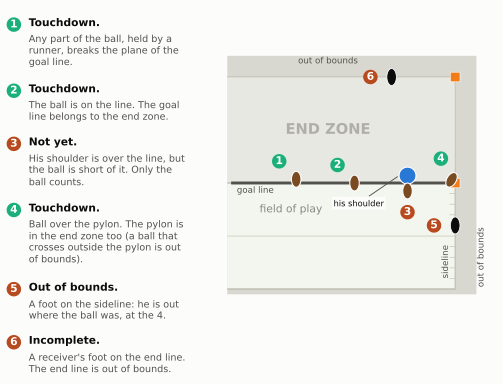
The end zone is the 10-yard-deep box at each end, between the goal line and the end line. An offense scores by getting the ball into the end zone it is attacking, and it defends the one behind it. The goal line is the line between the field of play and the end zone, and it has one property that surprises most new fans: the goal line is part of the end zone. A ball carried onto the goal line is already a touchdown. Officials talk about the ball “breaking the plane”: the goal line is treated as an invisible wall rising straight up from the paint, and the moment any part of the ball, in a runner’s control, touches that wall, the play is over and six points go on the board. The orange pylons at the four corners of each end zone are in the end zone too, so a ball carried over or inside a pylon counts.4

The goal posts stand on the end line, at the back of the end zone. Their crossbar is 10 feet off the ground, the uprights are 18 feet 6 inches apart and rise 35 feet above the crossbar.5 They haven’t always been there; we’ll see why they moved when we get to the field goal.

Sidelines: where the game stops

A sideline is one of the two long boundary lines. Together with the end lines, the sidelines enclose the playing surface, and a solid white border at least 6 feet wide runs outside them. Here is the rule that matters more than any other on this page: the sideline is out of bounds. So is the end line. A runner who puts one toe on the white paint is out of bounds, and the play ends where the ball was when he did it. The goal line is in, the boundary lines are out. Here are the edge cases.

Show the Python
fig = plt.figure(figsize=(6.5, 4.3))
gs = fig.add_gridspec(1, 2, width_ratios=[1.0, 1.25], wspace=0.02)
axk = fig.add_subplot(gs[0]); blank(axk)
ax = fig.add_subplot(gs[1])
fld = Field(ax=ax, orient="vertical", los=90, window=(10, 30), to_go=None, lateral=(0.0, 21.0))
field_extras(fld, posts=False, try_lines=False, pylon_size=0.9)
P = fld.xy
x_lo, _ = ax.get_xlim(); y_lo, _ = ax.get_ylim()
ax.set_xlim(x_lo, FIELD_WIDTH + 3.6); ax.set_ylim(y_lo, 123.2)
ax.text(*P(103.0, -2.45), "out of bounds", rotation=90, fontsize=6.5, ha="center", va="center", color=style.INK_2)
ax.text(*P(121.5, 12.0), "out of bounds", fontsize=6.5, ha="center", va="center", color=style.INK_2)
ax.text(*P(115.0, 12.0), "END ZONE", fontsize=11, ha="center", va="center", color=style.MUTED, alpha=0.6,
        fontweight="bold")
ax.text(*P(107.5, 15.5), "field of play", fontsize=8, ha="center", va="center", color=style.MUTED)
ax.text(*P(109.7, 20.6), "goal line", fontsize=6.5, ha="left", va="top", color=style.INK_2)
ax.text(*P(101.0, 0.9), "sideline", rotation=90, fontsize=6.5, ha="center", va="bottom", color=style.INK_2)
gx, gy = P([110, 110], [0, 21])
ax.plot(gx, gy, color=style.INK_2, lw=2.2, zorder=2)          # the goal line, painted IN the end zone

cases = [(1, (110.35, 15.0), 90, True), (2, (110.0, 9.5), 90, True), (3, (109.25, 4.5), 90, False),
         (4, (110.3, 0.35), 60, True), (5, (106.0, 0.0), 90, False), (6, (120.0, 6.0), 90, False)]
offs = {1: (-1.6, 1.7), 2: (-1.6, 1.7), 3: (0.0, -2.0), 4: (-1.0, 2.0), 5: (-2.0, 0.0), 6: (-2.0, 0.0)}
for num, (bx, by), ang, good in cases:
    px, py = (float(v) for v in P(bx, by))
    if num in (5, 6):   # a foot touching a boundary line
        ax.add_patch(Ellipse((px, py), 0.9, 1.6, facecolor=style.INK, edgecolor="white", lw=0.6, zorder=12))
    else:
        football(ax, px, py, w=1.5, h=0.9, angle=ang)
    if num == 3:        # his shoulder is over the line, the ball is not
        draw_marker(ax, *(float(v) for v in P(110.7, 4.5)), "off", "", 10, r=0.8)
        sx, sy = (float(v) for v in P(110.7, 4.5))
        callout(ax, "his shoulder", (sx - 0.8, sy), (sx - 4.6, sy - 2.6), fs=6.2)
    col = style.THIRD if good else style.DEFENSE_DARK
    ax.text(px + offs[num][0], py + offs[num][1], str(num), fontsize=8, fontweight="bold", color="white",
            ha="center", va="center", zorder=13, bbox=dict(boxstyle="circle,pad=0.18", fc=col, ec="none"))
clip_texts(ax)

key = [(True, "Touchdown.", "Any part of the ball, held by a runner, breaks the plane of the goal line."),
       (True, "Touchdown.", "The ball is on the line. The goal line belongs to the end zone."),
       (False, "Not yet.", "His shoulder is over the line, but the ball is short of it. Only the ball counts."),
       (True, "Touchdown.", "Ball over the pylon. The pylon is in the end zone too (a ball that crosses outside the pylon is out of bounds)."),
       (False, "Out of bounds.", "A foot on the sideline: he is out where the ball was, at the 4."),
       (False, "Incomplete.", "A receiver's foot on the end line. The end line is out of bounds.")]
y = 0.97
for i, (good, head, body) in enumerate(key, 1):
    col = style.THIRD if good else style.DEFENSE_DARK
    axk.text(0.02, y, str(i), transform=axk.transAxes, fontsize=8, fontweight="bold", color="white",
             ha="center", va="top", bbox=dict(boxstyle="circle,pad=0.18", fc=col, ec="none"))
    axk.text(0.09, y + 0.004, head, transform=axk.transAxes, fontsize=8, fontweight="bold", color=style.INK,
             ha="left", va="top")
    lines = textwrap.wrap(body, 34)
    axk.text(0.09, y - 0.045, "\n".join(lines), transform=axk.transAxes, fontsize=7.2,
             color=style.INK_2, ha="left", va="top", linespacing=1.2)
    y -= 0.085 + 0.041 * len(lines)
plt.show()
Figure 3.2: The goal line is in; the sideline and end line are out. A close-up of one corner of an end zone, offense attacking up the page. Only the ball counts for a touchdown (cases 1 to 4), but for out of bounds, any part of the player counts (cases 5 and 6).

The asymmetry is deliberate. The end zone is a reward, so the rules are generous about reaching it: the ball only has to touch the plane. The sidelines are a limit, so the rules are strict about crossing them: a toenail on the paint is enough. Notice also that the two tests look at different things. For a touchdown, only the ball matters, so a runner can be falling out of bounds and still score if the ball crossed the plane first (case 4). For out of bounds, the player matters: if any part of him touches the line while he holds the ball, the ball is out at that spot, even if the ball itself is still over the field.

CautionCommon misconception

“He has to get into the end zone.” A runner doesn’t: only the ball does, which is why you see backs stretch the ball out over the goal line while their bodies are being driven backward. A receiver catching a pass in the end zone is different. He has to complete the catch with both feet (or a knee, hip or elbow) down in bounds, which is why the toe-tap along the back line gets reviewed so often. What counts as a catch is its own small body of law; it’s in Officiating, Replay, and the Rules of the Ball.

Hash marks: where every play starts

Look down the middle of the field and you’ll see two rows of short dashes running its whole length. These are the hash marks (the rulebook calls them inbounds lines), and in the NFL they sit 70 feet 9 inches in from each sideline, which leaves them 18 feet 6 inches apart. That gap is exactly the width of the goal posts, and that’s no accident, as you’ll see below.

The rule that makes them matter is simple. Every play from scrimmage starts with the ball on or between the hash marks. If a play ends between them, the next one starts where the ball was declared dead. If it ends outside them, say a runner is tackled 4 yards from the sideline or runs out of bounds, the officials carry the ball in to the nearer hash. So most snaps start on one hash or the other, and the ball’s position across the field changes from play to play. Watch for it: the camera will show the ball sitting on the left or the right hash far more often than dead center. There are two exceptions. On the try after a touchdown and on the first snap after a touchback, the offense may put the ball anywhere on or between the hashes, so a team can snap its extra point from wherever its kicker likes best.6

Why it exists: the indoor game of 1932

The NFL didn’t always have hash marks. Before 1933, the next play generally started where the last one ended, so a runner tackled a yard from the sideline left his team snapping the ball a yard from the sideline, with almost no room on one side of the formation. Teams were stuck with a lopsided formation and often spent a play just running back toward the middle to get room back. The fix came from an accident. The 1932 season ended with the Chicago Bears and the Portsmouth Spartans tied for first, and a blizzard drove the playoff game indoors to Chicago Stadium, onto a makeshift field only 80 yards long and 30 feet narrower than normal, with the stands right up against the sidelines. A special rule for that game let the ball be moved in from the walls after plays that ended near them (accounts differ on the details). The game worked so well that for 1933 the league wrote the idea into the rulebook: the ball would be spotted on the hash marks on every play.7

The hashes then crept toward the middle of the field. They were 10 yards from the sidelines in 1933, 15 yards from 1935, 20 yards from 1945, and in 1972 the NFL moved them to 23 yards, 1 foot and 9 inches, the same width as the goal posts.8 Each move gave the offense more room to the short side and made the field more symmetrical. The 1972 change was made to help offenses after a drop in scoring, one of a string of 1970s rule changes with the same aim, a story told in From the Single Wing to the Scoring Drought.9

Field side and boundary side

When the ball is on a hash, it is no longer in the middle of the field, so the two sides of the formation are different sizes. The side with more room is the field side, also called the wide side. The side closer to the sideline is the boundary side, or short side. In the NFL the difference is 23.6 yards versus 29.8 yards: about 6 yards. When the ball is in the middle of the field, neither side is the field side, and teams use some other rule to decide which way to call things, usually the side with more receivers (the formation’s strength, built out in Formation Rules and Vocabulary).

Six yards may not sound like much, but with eleven players a side, the sideline acts like a twelfth defender: a runner or receiver headed toward it runs out of room, and the defense can use it to trap him. The difference matters most for plays that stretch to the edge (sweeps, throws toward the sideline, screens to the outside) and hardly at all for plays between the hashes. So the hash changes the plan on both sides of the ball:

  • Offense. Plays that need room to run sideways (sweeps, wide runs, screens to the outside, receivers breaking toward the sideline) usually go to the field. Throws to the boundary are shorter, because the quarterback is closer to that sideline, so quick throws outside are safer there. Many offenses line up most of their receivers to the wide side so they have room to spread out, and leave one receiver alone to the boundary.
  • Defense. Many defenses assign roles by side rather than by left and right: a “field corner” and a “boundary corner,” a field safety and a boundary safety. The boundary corner can play more aggressively, because the sideline takes away his outside; the field corner has acres to defend. So teams that play this way cast the parts to fit: the boundary corner is often the bigger, more physical player who presses and tackles, the field corner the better cover man in space, and the boundary safety the one who comes up to stop the run. When the offense stacks receivers to the wide side, these defenses slide their safeties that way too, leaving the boundary corner alone against the single receiver. This is mostly a college habit: with the NFL’s narrow hashes, many pro defenses set their calls by the formation’s strength instead. Playing a different coverage to each side is a whole family of schemes, which you’ll meet in Disguise, Rotation, and Split-Field Coverage.
  • Kickers. A field goal is snapped from wherever the last play ended, so one from a hash is kicked at a slight angle. Because NFL hashes are only as wide as the uprights, the angle is mild, which is one reason NFL teams rarely spend a down centering the ball (running a play toward the middle so it is spotted there) before a kick, a habit you’ll see more in college.

NFL versus college versus high school

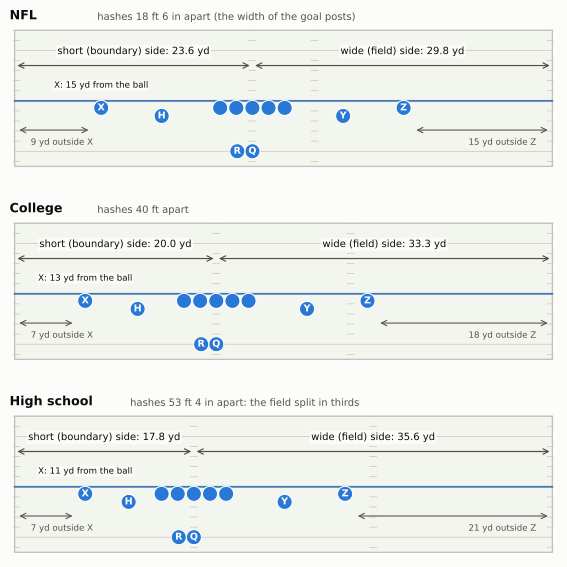
The hash marks are the biggest difference between the fields you see on Saturday and Sunday. College hashes are 40 feet apart, 60 feet from each sideline; high school hashes are 53 feet 4 inches apart, splitting the field into thirds.10 The fields are the same size. The only thing that changes is where the ball can start.

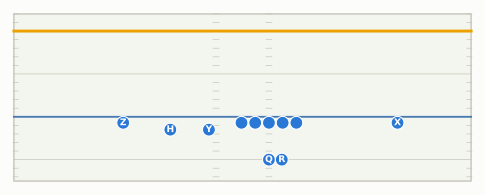
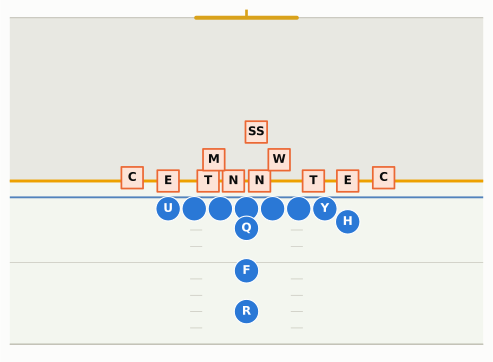
The next picture is the chapter’s first with players in it, so here is how to read every diagram in this book. Blue circles are the offense, orange squares the defense, and the offense always moves up the page (or, in a wide picture, to the right). The letters name positions: Q is the quarterback, R a running back, and X, Z, H and Y are receivers. The five blank circles in a row are the offensive linemen. You don’t need the letters yet; they’re decoded in The Twenty-Two.

Show the Python
LEVELS = [("NFL", HASH_NEAR, "hashes 18 ft 6 in apart (the width of the goal posts)"),
          ("College", 20.0, "hashes 40 ft apart"),
          ("High school", FIELD_WIDTH / 3, "hashes 53 ft 4 in apart: the field split in thirds")]
fig, axes = plt.subplots(3, 1, figsize=(6.5, 5.9))
for ax, (name, near, sub) in zip(axes, LEVELS):
    far = FIELD_WIDTH - near
    x_w = -min(15.0, near - 7.0)               # X: on his normal spot, or 7 yd off the sideline
    off = [q.moved(w=x_w) if q.key == "X" else q.moved(w=x_w * 0.6) if q.key == "H" else q
           for q in ch1(offense("gun_2x2"))]
    with hashes_at(near):
        p = Play(off, None, los=40, ball_y=far, to_go=None)
        fld = p.draw(ax=ax, window=(-6.5, 7.0), lateral="full", title=False)
    P = fld.xy
    hide_numbers(ax)              # the yard-line numbers would sit on top of the formation here
    for (y0, y1, side) in [(far, FIELD_WIDTH, "short (boundary) side"), (0.0, far, "wide (field) side")]:
        (ax0, ay0), (ax1, ay1) = P(43.5, y0), P(43.5, y1)
        ax.annotate("", xy=(float(ax0), float(ay0)), xytext=(float(ax1), float(ay1)),
                    arrowprops=dict(arrowstyle="<->", color=style.INK_2, lw=0.9), zorder=9)
        ax.text((float(ax0) + float(ax1)) / 2, float(ay0) + 0.9, f"{side}: {abs(y1 - y0):.1f} yd", fontsize=7.5,
                ha="center", va="bottom", color=style.INK, zorder=10,
                bbox=dict(boxstyle="round,pad=0.15", fc=style.SURFACE, ec="none", alpha=0.9))
    for key in ("X", "Z"):                     # room outside each outside receiver
        pl = p.players[key]
        bx, by = (float(v) for v in P(*p.to_abs(pl.d, pl.w)))
        edge = 0.0 if key == "X" else FIELD_WIDTH
        x_in = bx - 1.0 if key == "X" else bx + 1.0
        ax.annotate("", xy=(x_in, by - 2.2), xytext=(edge + (0.2 if key == "X" else -0.2), by - 2.2),
                    arrowprops=dict(arrowstyle="<->", color=style.INK_2, lw=0.8), zorder=9)
        ax.text(edge + (1.6 if key == "X" else -1.6), by - 3.0, f"{abs(bx - edge):.0f} yd outside {key}",
                fontsize=6.5, ha="left" if key == "X" else "right", va="top", color=style.INK_2, zorder=10)
    xb, yb = (float(v) for v in P(*p.to_abs(0.0, x_w)))
    ax.text(xb, yb + 1.1, f"X: {abs(x_w):.0f} yd from the ball", fontsize=6.5, ha="center", va="bottom",
            color=style.INK, zorder=10, bbox=dict(boxstyle="round,pad=0.12", fc=style.SURFACE, ec="none", alpha=0.9))
    ax.text(0.0, 1.02, name, transform=ax.transAxes, fontsize=9.5, fontweight="bold", color=style.INK,
            ha="left", va="bottom")
    ax.text(0.16 if name != "High school" else 0.22, 1.02, sub, transform=ax.transAxes, fontsize=7.5,
            color=style.INK_2, ha="left", va="bottom")
fig.subplots_adjust(hspace=0.32, left=0.01, right=0.99, top=0.95, bottom=0.01)
plt.show()
Figure 3.3: The same four-receiver formation (two receivers on each side) with the ball on the left hash, on three sets of hash marks. Receivers line up by landmarks, not by fixed distances from the ball: the receiver to the short side (X) won’t stand much closer than about 7 yards to the sideline, so he has room to run toward it. On the NFL field (23.6 yards to one sideline, 29.8 to the other) he can stand at his normal spot. On the college and high-school fields he has to cut in toward the ball, squeezing everything on the short side, while the wide side has more room than anyone can use.

This one measurement explains a lot of the difference between college and pro offense. A college offense with the ball on the hash has a huge wide side to attack and a cramped short side, so the field itself tells everyone where the space is, and college schemes lean hard on “to the field” and “into the boundary” rules. An NFL field is close to symmetrical, so alignment and play design depend less on the hash and more on the formation and the defense. It’s also why an NFL quarterback has to make the throw outside to both sides of the field: there is no cramped short side where every throw toward the sideline is a short toss, and the boundary throw is almost as long as the field throw. The college game as the sport’s laboratory is a recurring thread in The College Laboratory.

Scoring: five ways onto the scoreboard

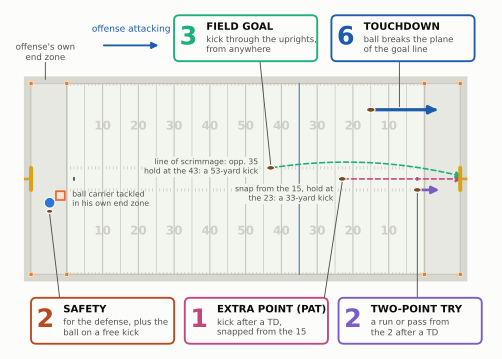
There are only five ways to score, and three of them come in a bundle: the touchdown and the two kinds of try that follow it.11

Show the Python
fig, ax = plt.subplots(figsize=(6.6, 4.6))
fld = Field(ax=ax, orient="horizontal", window=None, los=60, to_go=None)
field_extras(fld)
for t in ax.texts:
    t.set_alpha(0.35)


def badge(cx, cy, pts, name, how, col):
    ax.add_patch(FancyBboxPatch((cx - 20, cy - 6.4), 40, 12.8, boxstyle="round,pad=0.02,rounding_size=1.5",
                                fc=style.SURFACE, ec=col, lw=1.4, zorder=8))
    ax.text(cx - 16.0, cy + 0.1, str(pts), fontsize=19, fontweight="bold", color=col, ha="center", va="center",
            zorder=9)
    ax.text(cx - 11.0, cy + 3.1, name, fontsize=7.6, fontweight="bold", color=style.INK, ha="left", va="center",
            zorder=9)
    ax.text(cx - 11.0, cy - 1.8, how, fontsize=6.4, color=style.INK_2, ha="left", va="center", zorder=9,
            linespacing=1.15)


def lead(p0, p1):
    ax.plot([p0[0], p1[0]], [p0[1], p1[1]], color=style.INK_2, lw=0.7, zorder=7)


TD, KICK, PATC, TRY, SAF = style.OFFENSE_DARK, style.THIRD, "#c2477a", "#7a5cc4", style.DEFENSE_DARK
ax.plot([95, 113], [46, 46], color=TD, lw=2.4, zorder=5, solid_capstyle="round")      # a TD run, mid-play
arrow(ax, (110, 46), (114, 46), color=TD, lw=2.4, head=12)
football(ax, 95, 46, w=2.4, h=1.4)
football(ax, 87, MID, w=2.2, h=1.3)               # extra point: snapped from the middle (a try may be spotted anywhere between the hashes)
arrow(ax, (87, MID), (121, MID), color=PATC, lw=1.2, ls=(0, (3, 2)))
ax.text(84.5, MID - 1.6, "snap from the 15, hold at\nthe 23: a 33-yard kick", fontsize=5.8, color=style.INK_2,
        ha="right", va="top", zorder=6, bbox=dict(boxstyle="round,pad=0.1", fc=style.TURF, ec="none"))
football(ax, 108, HASH_NEAR, w=2.2, h=1.3)        # two-point try from the 2, on a hash
arrow(ax, (108, HASH_NEAR), (114.5, HASH_NEAR), color=TRY, lw=2.0, head=11)
ax.plot([75, 75], [0, FIELD_WIDTH], color=style.OFFENSE_DARK, lw=1.0, alpha=0.6, zorder=2)   # field goal
football(ax, 67, HASH_FAR, w=2.2, h=1.3)
arrow(ax, (67, HASH_FAR), (121, MID + 0.6), color=KICK, lw=1.2, ls=(0, (3, 2)), rad=-0.1)
ax.text(63.5, HASH_FAR + 0.3, "line of scrimmage: opp. 35\nhold at the 43: a 53-yard kick", fontsize=5.8,
        color=style.INK_2, ha="right", va="center", zorder=6, bbox=dict(boxstyle="round,pad=0.1", fc=style.TURF, ec="none"))
draw_marker(ax, 5.2, 20.0, "off", "", 6, r=1.5)                 # safety: ball carrier tackled in his OWN end zone
draw_marker(ax, 8.2, 22.0, "def", "", 6, r=1.4)
football(ax, 5.2, 17.6, w=1.8, h=1.1)
ax.text(11.5, 21.0, "ball carrier tackled\nin his own end zone", fontsize=5.8, color=style.INK_2, ha="left", va="center",
        zorder=6)

badge(104, 66, 6, "TOUCHDOWN", "ball breaks the plane\nof the goal line", TD)
lead((103, 59.6), (103, 46.9))
badge(60, 66, 3, "FIELD GOAL", "kick through the uprights,\nfrom anywhere", KICK)
lead((64, 59.6), (67, HASH_FAR + 1.0))
badge(106, -13, 2, "TWO-POINT TRY", "a run or pass from\nthe 2 after a TD", TRY)
lead((108, -6.6), (108, HASH_NEAR - 0.9))
badge(63, -13, 1, "EXTRA POINT (PAT)", "kick after a TD,\nsnapped from the 15", PATC)
lead((82, -6.6), (87, MID - 0.9))
badge(20, -13, 2, "SAFETY", "for the defense, plus the\nball on a free kick", SAF)
lead((8, -6.6), (5.2, 16.8))
arrow(ax, (20, 64), (36, 64), color=style.OFFENSE_DARK, lw=1.4)
ax.text(28, 68.5, "offense attacking", fontsize=6.8, color=style.OFFENSE_DARK, ha="center", va="center")
ax.text(4, 62, "offense's own\nend zone", fontsize=6.5, color=style.INK_2, ha="center", va="center")
lead((4, 59.2), (4, 54.5))
ax.set_xlim(-6, 129)
ax.set_ylim(-21, 74)
blank(ax)
plt.show()
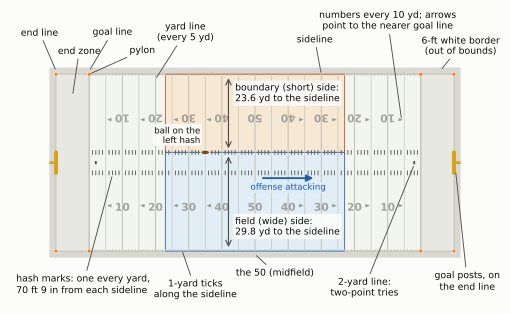
Figure 3.4: The five scores and where each one happens, offense attacking to the right. Four happen at the end the offense is attacking (the touchdown is shown as a run in progress; the two tries start between the hash marks, where the offense chooses). The safety happens at the other end, in the offense’s own end zone, and it counts for the defense. Field goals and extra points are measured to the goal posts, which stand on the end line, so a kick is about 18 yards longer than the line of scrimmage.

Touchdown: six points

A touchdown is worth six points. The offense scores one by running the ball across the goal line, or by catching a pass in the end zone. The defense or a kick-return team can score one too, by intercepting a pass or picking up a fumble and returning it all the way, or by returning a kick. Any recovery of a loose ball in the opponent’s end zone also counts. The touchdown is the point of the whole enterprise, and it is not easy: in 2025, only 23% of the times an NFL team got the ball ended with one.

The try: one point or two

After every touchdown, the scoring team gets one more snap, called the try, and the clock doesn’t run during it. It’s played even if time ran out on the touchdown, and skipped only when it can’t matter, as after a touchdown that wins the game in overtime. The team chooses between two very different plays:

  • The extra point (also the PAT, for “point after touchdown”) is a kick through the uprights worth one point. Since 2015 it has been snapped from the 15-yard line, so the kick itself, from about the 23, is about 33 yards.12
  • The two-point conversion is one ordinary play from the 2-yard line: run or pass the ball into the end zone and you get two points. The NFL adopted it only in 1994; the old AFL had used it in the 1960s and college football since 1958.13

On the try the defense can score too: if it blocks the kick, or intercepts or recovers on a two-point try, and returns the ball the length of the field, it gets two points. That rule also dates from 2015.

Why have two options at all? Because they are worth almost exactly the same on average, which makes the choice depend on the score, not on the play.

Show the Python
fig, ax = plt.subplots(figsize=(6.4, 3.0))
ax.plot(xp_rate.index, xp_rate.values, color=style.SERIES[2], marker="o", ms=3.5,
        label="Extra-point kick (1 point × success rate)")
ax.plot(tp_rate.index, 2 * tp_rate.values, color=style.SERIES[1], marker="o", ms=3.5,
        label="Two-point try (2 points × success rate)")
ax.axvline(2014.5, color=style.MUTED, lw=1, ls=(0, (3, 2)))
ax.text(2014.6, 1.13, "2015: kick moved\nback to the 15", fontsize=7.5, color=style.INK_2, ha="left", va="top")
ax.set_ylim(0.75, 1.15)
ax.set_ylabel("average points per try")
ax.set_xticks(range(2010, 2026, 3))
ax.legend(loc="lower left", fontsize=7.5)
plt.show()
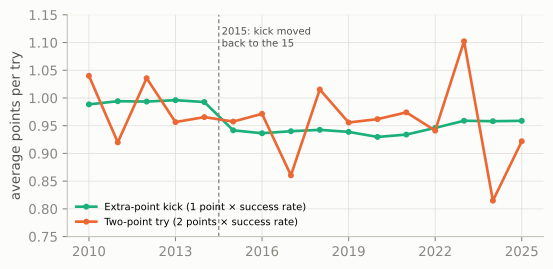
Figure 3.5: Average points per try, NFL regular seasons 2010–2025: the success rate times the points. Before 2015 the extra point, kicked from the 2, was a near-certain 1 point. Moving it back to the 15 cut its success to about 93–96%. The two-point try succeeds roughly half the time, so it is worth about the same; it bounces from year to year because there are only about 90–150 attempts a season.

The chart shows the history.14 For most of football history the extra point was close to automatic: 99.3% of kicks were good in 2014, when the ball was snapped from the 2 and the kick was a 20-yarder. A play that is always successful isn’t a decision, and the league moved the kick back to make it one. It worked a little: success fell to 94.2% the next season, and teams more than doubled their two-point attempts, from about 57 a season before the change to about 133 in 2021–2025. They’re still only about 10% of all tries, because when the two options are worth the same, most coaches take the one with less variance.

The real reason to go for two is the scoreboard. A team that trails by 2 after scoring wants the tie, and only the two-pointer gives it. A team that trails by 8 needs a touchdown and a two-pointer to tie. A team that is down 14 late and scores faces a classic question: kick to get within 7, or go for two now, so that it knows whether the next touchdown will tie or win? Analysts have argued that one for a decade; the arithmetic is in chapter 10.

Field goal: three points from anywhere

A field goal is worth three points. The offense snaps the ball back about 7 or 8 yards to a holder, who sets it on the ground, and the kicker kicks it through the goal posts. It can be tried from anywhere on the field, on any down, but in practice teams try it on fourth down, when the alternative is giving the ball away. Because the posts stand on the end line, add about 18 yards to the line of scrimmage to get the length of the kick: a field goal tried from the opponent’s 30 is a 48-yarder. A miss isn’t free. The other team takes over at the spot of the kick, where the holder set the ball (or at its own 20, if the kick came from inside it), so a missed 53-yarder hands it the ball at its own 43.15

Show the Python
fig, ax = plt.subplots(figsize=(6.4, 2.8))
ax.bar(fg_tab.index.astype(str), fg_tab.made * 100, color=style.SERIES[2], width=0.62)
for i, (n, m) in enumerate(zip(fg_tab.n, fg_tab.made)):
    ax.text(i, m * 100 + 1.5, f"{m:.0%}", ha="center", va="bottom", fontsize=8.5, color=style.INK)
    ax.text(i, 4, f"{n:,} kicks", ha="center", va="bottom", fontsize=7, color="white")
ax.set_ylim(0, 110); ax.set_yticks([0, 25, 50, 75, 100])
ax.set_ylabel("made (%)"); ax.set_xlabel("kick distance (yards), 2021–2025 regular seasons")
ax.grid(axis="x", visible=False)
plt.show()
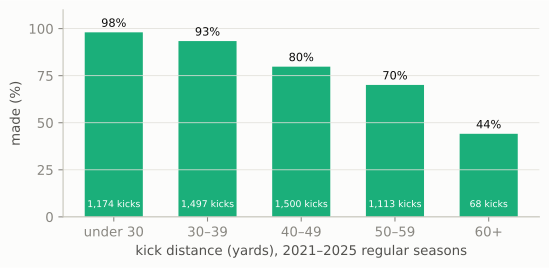
Figure 3.6: How often NFL field goals are made, by distance, 2021–2025 regular seasons. Inside 30 yards the kick is close to certain, and from 30–39 yards it is good more than nine times in ten; past 50 it is still made about seven times in ten. That reliability is new: in 2016 and again in 2019, kicks of 50 yards or more were made fewer than six times in ten.

Modern kickers are remarkable. Kicks from under 30 yards almost never miss, those from 30–39 miss only about one time in fifteen, and kicks of 50 yards or more, made fewer than six times in ten as recently as 2019, are now made about seven times in ten: in 2025 alone kickers made 12 field goals of 60 yards or more.16 That shifts strategy, because the farther out a team can count on three points, the sooner a stalled drive still scores.

The goal posts’ location is a strategy story too. From 1933 to 1973 the NFL’s posts stood on the goal line, at the front of the end zone, a holdover from that same indoor game of 1932. Field goals were 10 yards shorter, and coaches settled for them constantly. For 1974 the league moved the posts back to the end line, specifically to make field goals harder and push teams to play for touchdowns.17 The rules have been nudging coaches away from the three-point consolation prize for fifty years.

Safety: two points and the ball

A safety is the defense’s own score: two points, awarded when the offense’s ball carrier is tackled in his own end zone, when the offense fumbles the ball out of the back or side of its own end zone, or when the offense commits a foul in its own end zone (most often holding a pass rusher who was about to sack the quarterback there). The usual picture is a quarterback sacked a yard deep in his own end zone.

The safety comes with a second penalty. The team that gave it up must then kick the ball away from its own 20-yard line, a free kick that is usually punted. So the defense gets two points and the ball, usually near its own 40 (the median first snap after a safety in 2016–2025 was at the scoring team’s own 37). That makes a safety worth more than its two points suggest, and it’s why offenses backed up against their own goal line play so carefully. Safeties are rare: there were 12 in the whole 2025 regular season, about one every 23 games.18 (One oddity for trivia night: the rulebook even allows a one-point safety, which can happen only on a try. If a defender intercepts a two-point pass, runs it out of his own end zone and is tackled back inside it, the offense gets one point. You will probably never see one.)

The word “safety” also names a defensive position, the deepest defenders on the field. That one is covered in The Twenty-Two.

Seven versus three: the central tension

Add it up and an NFL score is almost always built from 7s (touchdown plus extra point) and 3s. The gap between them, four points, is the single most important number in football strategy. It is more than a field goal. A team that settles for a field goal when it could have scored a touchdown has left more points on the table than it just scored.

Show the Python
LABEL = {"Touchdown": "Touchdown", "Field goal": "Field goal", "Punt": "Punt",
         "Turnover": "Interception or lost fumble", "Opp touchdown": "Interception or lost fumble",
         "Turnover on downs": "Turnover on downs", "End of half": "Clock ran out (end of half)",
         "Missed field goal": "Missed field goal", "Safety": "Safety"}
share = drives.result.map(LABEL).value_counts(normalize=True).sort_values()
fig, ax = plt.subplots(figsize=(6.4, 3.0))
ax.barh(share.index, share.values * 100, height=0.68,
        color=[style.OFFENSE if k in ("Touchdown", "Field goal") else style.BASELINE for k in share.index])
for i, v in enumerate(share.values * 100):
    ax.text(v + 0.5, i, f"{v:.1f}%", va="center", ha="left", fontsize=8, color=style.INK)
ax.set_xlabel("share of all possessions, 2025 regular season")
ax.grid(axis="y", visible=False)
ax.set_xlim(0, 38)
ax.tick_params(axis="y", length=0, labelsize=8.5, labelcolor=style.INK)
plt.show()
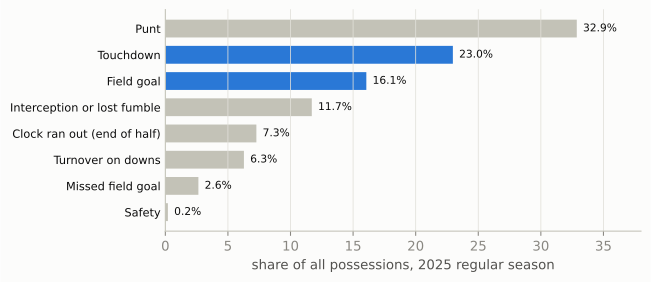
Figure 3.7: How every possession ended, 2025 NFL regular season. Fewer than four in ten produced points, and touchdowns outnumbered field goals only about three to two. Defensive and return touchdowns after a turnover are counted with the turnover.

Here’s why that gap matters so much. A possession is one turn with the ball (the next section is about them), and an NFL team gets only about 10.7 of them a game, scoring about 23 points in all (2025 figures).19 Each one is precious. When a drive reaches the opponent’s 20, the area called the red zone, it ended in a touchdown 57% of the time in 2025 and a field goal 29% of the time. A team that turns one of those field goals per game into a touchdown gains four points a week; over a 17-game season that’s almost 70 points, the kind of margin that separates an average team from a playoff team.

So the choice between 7 and 3 runs through every chapter that follows:

  • It’s why fourth down near the goal line is the most second-guessed call in football, and why the crowd at the top of this chapter booed the kicker. On fourth down from the 1- or 2-yard line, a single run or pass scored a touchdown 55% of the time in 2016–2025.20 You’ll use that number in the third Predict-the-play drill below.
  • It’s why offenses build whole playbooks for the red zone, where the field shrinks and the defense has less ground to cover (Red Zone, Goal Line, and Short Yardage).
  • It’s why a field goal on the opening drive is greeted with a shrug and a touchdown with a roar, even though both “scored.”
ImportantWhy it exists: a scoreboard built from 7s and 3s

Because almost all points come in chunks of 7 and 3, some margins matter far more than others. Leading by 3 means a field goal ties you; by 4, the opponent needs a touchdown; by 8, it needs a touchdown and a two-point conversion; by 9, two scores. Broadcasters call a 9-point lead “a two-score game” for exactly this reason. The same logic runs up the scale: 14 is two touchdowns with extra points, 16 is the most two touchdowns can cover (both with two-point conversions), and at 17 you need three scores. Listen for the margins 3, 7, 8, 14, 16 and 17 late in a game; they’re the ones coaches plan around, and they’re why a team up by 7 sometimes kicks a late field goal (to go up 10, two scores) instead of trying for a touchdown.

Possession: football is a game of turns

Underneath all the scoring is a simpler idea. At any moment one team has possession, control of the ball, and that team is the offense. The other is the defense. Unlike basketball or soccer, the teams don’t swap the ball back and forth in a flowing way; they take turns, and each turn (a possession, or drive) keeps going until something specific ends it:

  • The offense scores. After a touchdown and try, or after a field goal, the scoring team kicks off (kicks the ball downfield to the other team, described below). This is football’s built-in fairness: score, and you have to give the ball back.
  • The offense gives it up on purpose, by punting on fourth down: it trades the ball for 40-odd yards of field position rather than handing it over at the line of scrimmage.
  • The offense loses it: an interception, a lost fumble, failing on fourth down (all defined in Downs, Distance, and Field Position), or a missed field goal.
  • The defense scores a safety and then receives the free kick.
  • The half ends. Possession does not carry across halftime.

The drive-outcome chart above is a census of exactly these endings. With so few turns, each one is a scarce resource, and that scarcity is what makes the clock matter: a team that can’t stop the clock can’t buy itself another turn.

The shape of a game

Show the Python
fig, ax = plt.subplots(figsize=(6.6, 2.75))
blank(ax); ax.set_xlim(-2, 112); ax.set_ylim(-3, 40)
U = 1.4
starts = {1: 0, 2: 15 * U, 3: 30 * U + 8, 4: 45 * U + 8}
OTX = 60 * U + 8 + 3
for q, x in starts.items():
    ax.add_patch(FancyBboxPatch((x + 0.3, 12), 15 * U - 0.6, 10, boxstyle="round,pad=0,rounding_size=0.8",
                                fc=style.OFFENSE_TINT, ec=style.OFFENSE, lw=1.0, zorder=2))
    ax.text(x + 7.5 * U, 18.6, f"Q{q}", fontsize=10, fontweight="bold", color=style.OFFENSE_DARK, ha="center",
            va="center", zorder=3)
    ax.text(x + 7.5 * U, 14.7, "15:00", fontsize=7, color=style.INK_2, ha="center", va="center", zorder=3)
hx = 30 * U
ax.add_patch(FancyBboxPatch((hx + 0.5, 12), 7, 10, boxstyle="round,pad=0,rounding_size=0.8", fc=style.GRID,
                            ec=style.BASELINE, lw=1.0, ls=(0, (3, 2)), zorder=2))
ax.text(hx + 4.0, 17, "half-\ntime", fontsize=6.8, color=style.INK_2, ha="center", va="center", zorder=3,
        linespacing=1.05)
ax.add_patch(FancyBboxPatch((OTX, 12), 13.5, 10, boxstyle="round,pad=0,rounding_size=0.8", fc=style.SURFACE,
                            ec=style.BASELINE, lw=1.0, ls=(0, (3, 2)), zorder=2))
ax.text(OTX + 6.75, 17, "overtime\nif tied", fontsize=7, color=style.INK_2, ha="center", va="center", zorder=3)
for q in (2, 4):
    x = starts[q] + 13 * U
    ax.plot([x, x], [12, 24.5], color=style.DEFENSE_DARK, lw=1.4, zorder=4)
    ax.text(x, 25.3, "two-minute\nwarning", fontsize=6.5, color=style.DEFENSE_DARK, ha="center", va="bottom",
            linespacing=1.05)
for x, lab in ((starts[1], "coin toss,\nkickoff"), (starts[3], "kickoff, usually by the\nteam that received first")):
    ax.add_patch(Polygon([[x + 0.3, 22.4], [x + 2.1, 22.4], [x + 1.2, 24.0]], closed=True, fc=style.THIRD,
                         ec="none", zorder=4))
    ax.text(x + 0.3, 25.3, lab, fontsize=6.5, color=style.INK, ha="left", va="bottom", linespacing=1.05)
for q in (1, 3):
    x = starts[q] + 15 * U
    ax.text(x, 9.5, "⇄", fontsize=11, color=style.INK_2, ha="center", va="center")
    ax.text(x, 6.2, "teams switch ends;\nsame down, distance, spot", fontsize=6.3, color=style.INK_2,
            ha="center", va="top", linespacing=1.05)
for x0, x1, lab in ((starts[1], starts[2] + 15 * U, "first half: each team has 3 timeouts"),
                    (starts[3], starts[4] + 15 * U, "second half: 3 fresh timeouts each")):
    ax.annotate("", xy=(x0 + 0.3, 33.5), xytext=(x1 - 0.3, 33.5),
                arrowprops=dict(arrowstyle="|-|,widthA=0.3,widthB=0.3", color=style.INK_2, lw=0.8))
    ax.text((x0 + x1) / 2, 35.3, lab, fontsize=7, color=style.INK, ha="center", va="bottom")
ax.text(hx + 4.0, 9.5, "13 minutes. Nothing\ncarries over: new\nkickoff, new timeouts", fontsize=6.3,
        color=style.INK_2, ha="center", va="top", linespacing=1.05)
ax.text(OTX + 6.75, 9.5, "both teams get\nthe ball; 10 min\n(regular season)", fontsize=6.3, color=style.INK_2,
        ha="center", va="top", linespacing=1.05)
plt.show()
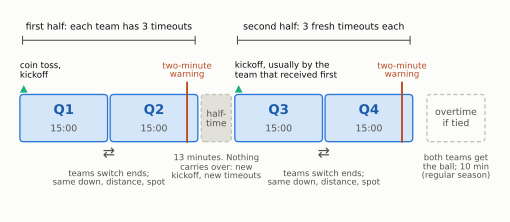
Figure 3.8: The shape of an NFL game in game-clock time: four 15-minute quarters, a halftime that resets the kickoff and the timeouts, a two-minute warning near the end of each half, and overtime if the score is tied. Teams switch ends after the first and third quarters but keep the ball, the down and the distance.

The coin toss. A few minutes before kickoff the referee tosses a coin at midfield, and the visiting captain calls it. The winner chooses to kick off or receive, or which goal to defend, and the loser gets the other choice. For the second half the order flips: the team that lost the toss gets first choice, and the other team takes the remaining one. The winner can also defer his choice to the second half, and most coaches now do:21 they kick off to start the game and are guaranteed the ball to start the second half. That matters because the end of a half is when a possession is worth the most. A team that has the ball as the first half runs out and then receives the second-half kickoff gets two turns in a row.22

The kickoff. Each half, and every possession after a score, starts with a kickoff: the kicking team kicks from its own 35-yard line and the other team catches the ball and tries to run it back. Its rules have changed every season since 2024, which is why it has its own chapter, Kickoffs and Returns.23 For now: a kickoff that lands in the end zone and isn’t run out is a touchback, and the receiving team starts at its own 35 (the spot since 2025).

Quarters. The game is 60 minutes of game-clock time, split into four quarters of 15 minutes. After the first and third quarters the teams switch ends, so neither side gets the wind or the sun for a whole half. Nothing else changes: the same team has the ball, at the mirror-image spot, with the same down and distance. A drive can run straight through the end of the first or third quarter.

Halftime. Between the second and third quarters there’s a 13-minute break (much longer at the Super Bowl, for the show). Halftime is a hard reset. Possession doesn’t carry over, unused timeouts disappear, and the second half starts with a fresh kickoff, usually by the team that received the first one.

The two-minute warning. In the second and fourth quarters, the officials stop the game after the last play that started with more than 2:00 on the clock: the two-minute warning. Snap at 2:04, tackle at 1:57, and the warning comes after that play, which is why an offense hurries to get a snap off just before 2:00. It’s an automatic timeout that belongs to neither team, and coaches count it as a free fourth timeout. It began as a real warning, when official time was kept on the field rather than on the scoreboard (until 1970); it survives because it’s useful, for strategy and for a guaranteed commercial break at the tensest moment of each half.24

Overtime. If the score is tied after four quarters, the game goes to overtime, which starts with a new coin toss. The rules are different for the regular season and the playoffs, and both changed recently. Since 2025, both teams get at least one possession in regular-season overtime too (the playoffs adopted this in 2022); after that, the next score wins. Regular-season overtime is one 10-minute period, and a game still tied after it ends a tie. Playoff overtime uses 15-minute periods and continues until someone wins.25 Until 2022 in the playoffs (2025 in the regular season), a touchdown on the first possession ended the game; the Chiefs film room below shows the game that changed that, and overtime strategy is in Clock and Game Management.

Put together, a game is a long chain of turns: about 150 snaps in all, roughly 121 of them runs and passes and the rest kicks.26 Sixty minutes of clock, about 11 minutes of action, and the clock rules decide how the sixty are spent.

The game clock: when it runs and when it stops

The game clock is the big clock on the scoreboard and in the corner of your TV, counting down each 15-minute quarter. It is the official time. It runs during every play, which is no surprise. What surprises people is that it often keeps running between plays too. Whether it does depends entirely on how the last play ended.27

Show the Python
RUN_C, STOP_C = "#dff3ea", "#fbe3d9"
fig, ax = plt.subplots(figsize=(6.6, 5.0))
blank(ax); ax.set_xlim(0, 100); ax.set_ylim(0, 76)
box(ax, 50, 71.5, 56, 7, "The play is over. What just happened?", ec=style.INK_2, bold=True, fs=9)
cols = [10, 30, 50, 70, 90]
events = [("Tackled\nin bounds", "runs, sacks, catches;\nfirst downs too"),
          ("Incomplete\npass", "a spike or a\nthrowaway too"),
          ("Out of\nbounds", "runner or receiver\nleaves the field"),
          ("Score or\nturnover", "or any other change\nof possession"),
          ("Timeout,\nflag, injury", "two-minute warning,\nmeasurements too")]
for x, (head, sub) in zip(cols, events):
    ax.plot([50, x], [68, 61.5], color=style.BASELINE, lw=1.0, zorder=1)
    box(ax, x, 54.5, 18.6, 14, head, sub=sub, fs=7.8, sub_fs=5.9, bold=True)
    ax.plot([x, x], [47.5, 44], color=style.BASELINE, lw=1.0, zorder=1)
box(ax, cols[0], 40.5, 18.6, 7, "CLOCK RUNS", fc=RUN_C, ec=style.THIRD, bold=True, fs=7.9)
for x in cols[1:]:
    box(ax, x, 40.5, 18.6, 7, "CLOCK STOPS", fc=STOP_C, ec=style.DEFENSE_DARK, bold=True, fs=7.9)
ax.text(50, 33.4, "When does it start again?", fontsize=8, fontstyle="italic", color=style.INK_2, ha="center",
        va="center", bbox=dict(boxstyle="round,pad=0.2", fc=style.SURFACE, ec="none"), zorder=3)
for x in cols:
    ax.plot([x, x], [37, 30], color=style.BASELINE, lw=1.0, zorder=1)
box(ax, cols[0], 23.5, 18.6, 13, "Never stopped.", sub="the play clock\nresets to 40", fs=7.3, sub_fs=6.2)
box(ax, cols[1], 23.5, 18.6, 13, "On the snap.", sub="which is why a spike\n'stops the clock'", fs=7.3, sub_fs=6.2)
box(ax, cols[2], 23.5, 18.6, 13, "Late in a half?", sub="after the 2:00 warning\nof the 1st half, or\nin the last 5:00 of Q4",
    fs=7.3, sub_fs=5.8)
box(ax, cols[3], 23.5, 18.6, 13, "On the snap,", sub="or, after a kickoff,\nwhen a returner\ntouches the ball",
    fs=7.3, sub_fs=6.0)
box(ax, cols[4], 23.5, 18.6, 13, "It depends.", sub="timeout: on the snap.\nflag, injury: often\nas if it hadn't",
    fs=7.3, sub_fs=5.8)
ax.plot([cols[2], 39.5], [17, 12.2], color=style.BASELINE, lw=1.0)
ax.plot([cols[2], 60.5], [17, 12.2], color=style.BASELINE, lw=1.0)
ax.text(cols[2] - 7.0, 15.4, "yes", fontsize=6.5, color=style.INK_2, ha="center")
ax.text(cols[2] + 7.0, 15.4, "no", fontsize=6.5, color=style.INK_2, ha="center")
box(ax, 39.5, 6.8, 19.5, 10.5, "Yes: on the snap.", sub="late-game time is\nprotected", fs=7.0, sub_fs=6.1)
box(ax, 60.5, 6.8, 19.5, 10.5, "No: on the referee's", sub="ready signal, once the\nball is re-spotted", fs=7.0,
    sub_fs=6.1)
plt.show()
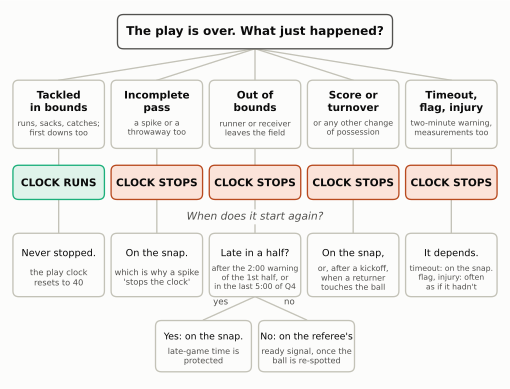
Figure 3.9: After this play, is the clock running? Read from the top. The one ending that keeps the clock running is a ball carrier tackled in bounds (including a sack, and including a first down). Every other ending stops it, and the question becomes when it starts again. For a play that goes out of bounds, the answer depends on the time of the game.

Walk through it once and the logic becomes obvious:

  • A ball carrier tackled in bounds: the clock keeps running. That includes a quarterback sacked behind the line and, in the NFL, a play that gains a first down. The officials need a few seconds to spot the ball, and those seconds tick away.
  • An incomplete pass stops the clock, and it stays stopped until the next snap. This is why a quarterback in a hurry will spike the ball, throwing it straight into the turf the moment it’s snapped: it’s an intentional incomplete pass that buys a stopped clock for the price of a down.
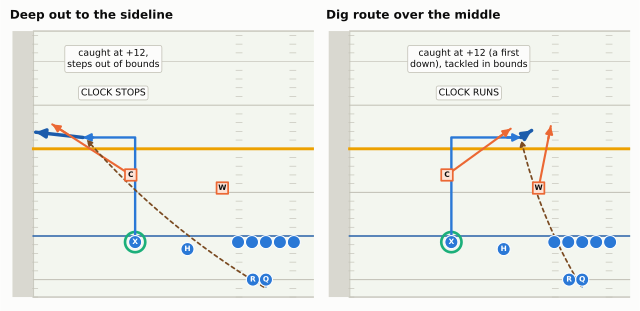
  • Out of bounds stops the clock, but for most of the game only briefly. Normally, once the officials have put the ball back on the hash and the referee signals it’s ready for play, the clock starts again, well before the snap. But after the two-minute warning of the first half, and in the last five minutes of the game, it stays stopped until the snap. That exception, the out-of-bounds clock rule, is why the broadcaster praised the receiver who got out of bounds in the opening scene, and why a defense protecting a late lead tries so hard to tackle receivers inside the field. (One out-of-bounds ending never gets the late-game protection: a fumble that bounces out restarts on the ready signal, so nobody can fumble out of bounds on purpose to save time.)
  • Any score or change of possession stops the clock. After a score it starts again on the kickoff, but only when someone legally touches the ball in the field of play, so a kickoff that ends in a touchback takes no time at all. After a turnover or punt it starts on the next snap.
  • A timeout, a penalty flag, an injury, the two-minute warning or a measurement for a first down all stop it. When it restarts varies: after a team timeout or the two-minute warning, on the snap; after most flags and injuries, the clock starts again as if the stoppage hadn’t happened (so if it was running, it runs again when the ball is ready). Late in each half the rules tighten, so that a team can’t use a deliberate foul or a fake injury to save time; an offense that does can be charged a 10-second runoff, ten seconds taken straight off the clock. (A defense is never charged a runoff; it loses the stoppage instead.)
Show the Python
def clock_play(kind):
    dfn = [Player("CB", "CB", "def", 7.0, -15.5, label="C"), Player("WILL", "WILL", "def", 5.5, -5.0, label="W")]
    p = Play(ch1(offense("gun_2x2")), dfn, los=55, to_go=10)
    p.dropback(1.0)
    if kind == "out":
        p.route("X", r.out(12, 6))
        time_pass(p, "X")
        p.run("X", [(0.6, -5.4)])                          # turns upfield and steps out of bounds
        p.path("CB", [(12.8, -24.5)], absolute=True)
        p.note("caught at +12,\nsteps out of bounds", at=(20.3, -17.5))
        p.note("CLOCK STOPS", at=(16.4, -17.5))
    else:
        p.route("X", r.dig(12, 8))
        time_pass(p, "X")
        p.run("X", [(0.8, 1.2)])
        p.path("CB", [(12.3, -8.2)], absolute=True)
        p.path("WILL", [(12.6, -3.6)], absolute=True)
        p.note("caught at +12 (a first\ndown), tackled in bounds", at=(20.3, -13.0))
        p.note("CLOCK RUNS", at=(16.4, -13.0))
    p.highlight("X")
    return p


fig, axes = plt.subplots(1, 2, figsize=(6.6, 4.1))
for ax, kind, title in zip(axes, ("out", "dig"), ("Deep out to the sideline", "Dig route over the middle")):
    p = clock_play(kind)
    fld = p.draw(ax=ax, window=(-7, 23.5), lateral=(-26.67, 5.0), title=False)
    hide_numbers(ax)
    P = fld.xy
    (x0, y0), (x1, y1) = P(55 - 7, FIELD_WIDTH), P(55 + 23.5, FIELD_WIDTH + 2.4)   # out-of-bounds border
    lo, hi = sorted([float(x0), float(x1)])
    ax.add_patch(Rectangle((lo, min(float(y0), float(y1))), hi - lo, abs(float(y1) - float(y0)),
                           facecolor=BORDER, edgecolor="none", zorder=0.8))
    ax.set_xlim(lo - 0.3, ax.get_xlim()[1])
    clip_texts(ax)
    ax.set_title(title, fontsize=9, fontweight="bold", color=style.INK, loc="left")
fig.subplots_adjust(wspace=0.04, left=0.01, right=0.99, top=0.93, bottom=0.01)
plt.show()
Figure 3.10: Same gain, two different clocks. In both panels the receiver X (outlined) catches the ball 12 yards downfield for a first down; the brown dotted line is the pass, the thick dark line his run after the catch. On the left he runs an out route (straight downfield, then a sharp break toward the sideline) and steps out of bounds: the clock stops. On the right he runs a dig (the same stem, breaking toward the middle instead), and the cornerback (C) and a linebacker (W) tackle him in bounds: the clock keeps running while everyone hurries back to the line.

Once you see the clock this way, a lot of late-game football explains itself. A team that is behind wants the clock stopped, so it throws passes (an incompletion stops the clock too) and aims for the sidelines. A team that is ahead wants the clock running, so it runs the ball, keeps its receivers in bounds, and takes as long as the rules allow between snaps. Its defense plays the same game: defensive backs line up outside their receivers to take away the throw to the sideline (the left panel above), and concede the catch over the middle, where the tackle keeps the clock running (the right panel). Taken to the extreme, the logic produces plays that look like mistakes. In Super Bowl XLVI (February 2012), the Patriots led the Giants 17–15, but New York had the ball at the Patriots’ 6 with 1:04 left, and New England couldn’t stop the clock enough: the Giants could run it down and kick a chip-shot field goal to win at the gun. So Bill Belichick told his defense to let them score. Ahmad Bradshaw, who realized it and tried to stop short, tumbled in from 6 yards out, and Tom Brady got the ball back, down 21–17, with 57 seconds to play. The mirror image came from the Eagles at Dallas in December 2007: Brian Westbrook broke into the clear with 2:19 left and the Cowboys out of timeouts, and stopped at the 1-yard line, so Philadelphia could kneel three times and end the game without giving the ball back.28 Late in a close game, almost every call is a clock call as much as a yardage call. Coaches have names for the two modes, the two-minute drill and the four-minute offense, both built out in chapter 10.

CautionCommon misconception

“The clock stops on a first down.” Not in the NFL, and that’s a habit carried over from college football, where for decades the clock stopped briefly after every first down. Even college dropped that in 2023, except in the last two minutes of each half, to shorten games.29 In the NFL a first down doesn’t stop the clock.

Timeouts

A timeout is a stoppage a team asks for. The head coach or any player on the field can call one. Each team gets three per half, and unused first-half timeouts don’t carry into the second half; in regular-season overtime each team gets two.30 A timeout stops the game clock at once, and the clock then starts again on the next snap.

Teams use timeouts for three different jobs, and good coaches know which job they’re paying for:

  1. To stop the clock late in a half, when time is worth more than anything. This is the most valuable use, and the reason announcers count a team’s remaining timeouts aloud in the final minutes. Each one is worth roughly 40 seconds that would otherwise have run off between plays.
  2. To avoid a penalty or a bad play, when the play clock is about to hit zero, the wrong players are on the field, or the quarterback doesn’t like what the defense is showing.
  3. To talk, or to make the other team think: a defense can call one just before a field-goal attempt to make the kicker wait (only once per kick; a second try is a penalty).

The tension is that jobs 2 and 3 spend the resource job 1 needs. A team that burns two timeouts on substitution mix-ups in the third quarter may have nothing left when it needs to stop the clock at the end of the game.

The play clock: forty seconds between snaps

The game clock isn’t the only clock. A second one, the play clock, counts down the time between plays; you’ll see it in the corner of the screen and on posts above each end zone. When a play ends, it starts at 40 seconds, and the offense must snap the ball before it reaches zero. If it doesn’t, it’s a five-yard delay of game penalty. After certain administrative stoppages (a timeout, a change of possession, a penalty enforcement, the two-minute warning, the start of a quarter) the play clock starts at 25 seconds instead, once the referee has spotted the ball and blown his whistle.31

ImportantWhy it exists: two clocks, two jobs

The two clocks measure different things. The game clock measures how much football is left. The play clock keeps the game moving by limiting how long an offense can stand around between snaps. The 25-second version exists because after a long stoppage both teams already know what’s coming and have had time to talk, so there’s no need to give them 40 more seconds; the 40-second version starts the instant a play ends, so it already covers the time it takes to get up, unpile and walk back.

Most of the time the two clocks run together, and that combination is the most important arithmetic in late-game football. If the game clock is running, every snap can burn up to 40 seconds of it, plus however long the play itself takes. A team with the lead and a fresh set of downs can simply have its quarterback kneel down three times, letting the play clock run nearly to zero before each snap, and drain about two minutes without risking a fumble, if the other team is out of timeouts; that’s the victory formation you see to end so many games. The trailing team’s only defense is to stop the game clock, and its timeouts are the only tool it has: each one gives back roughly 40 seconds. So “they have three timeouts left” really means “they can stop the bleeding three times.”

The play clock also shapes everything that happens before a play. Choosing the play, sending it in, huddling, lining up and reading the defense all have to fit inside those 40 seconds, and the coach’s radio to the quarterback even cuts out with 15 seconds left. That chain is the subject of What a Play Really Is, and what the offense does in the final seconds before the snap is The Pre-Snap Phase.

NoteFilm room: Chiefs 2021 — thirteen seconds

The most famous lesson in clock rules came in the AFC Divisional round on January 23, 2022 (the 2021 season), Buffalo at Kansas City. The last two minutes produced three touchdowns. Buffalo went ahead 29–26 with 1:54 left; Kansas City answered with a 64-yard touchdown by Tyreek Hill to lead 33–29; and Josh Allen’s 19-yard touchdown pass to Gabriel Davis and the extra point put the Bills back ahead, 36–33, with 13 seconds left.32

Then three clock details decided the game:

  1. The kickoff took no time. Buffalo’s kicker boomed the ball into the end zone for a touchback. Because the clock only starts when the ball is touched in the field of play, the Chiefs started at their own 25 (the touchback spot in 2021; it’s the 35 now) with all 13 seconds still on the clock.
  2. Two completions in bounds, two timeouts. Patrick Mahomes hit Tyreek Hill for 19 yards (the clock ran from 0:13 to 0:08, and Kansas City called timeout), then Travis Kelce for 25 yards to the Bills’ 31 (0:08 to 0:03, timeout). Neither receiver went out of bounds, which didn’t matter: Kansas City had timeouts to spend, and spent them.
  3. A 49-yard field goal at 0:03 by Harrison Butker, from the 31 (31 + 18), tied it 36–36.

Kansas City won the overtime coin toss, drove the length of the field, and won 42–36 on Mahomes’s 8-yard touchdown pass to Kelce. Under the rules then in force, that first-possession touchdown ended the game; Allen never touched the ball in overtime. The league changed playoff overtime for the next season so that both teams get a possession, and in 2025 extended that to the regular season.

What to notice: thirteen seconds was enough because of where the plays happened and what the Chiefs had left. Two timeouts plus a kickoff that didn’t run the clock turned 13 seconds into three snaps. With Kansas City holding timeouts, the usual late-game rule (keep catches in bounds) bought Buffalo nothing; the only thing that mattered was yards, so its defense had to take away the 20-yard catch anywhere on the field, and the 25-yarder to Kelce came over the middle. Buffalo’s other option was a squib kick, a low, bouncing kickoff that someone has to field and return, burning a few of the 13 seconds. Both are now standard talking points in exactly that situation.

Film room: Super Bowl LIX on one field

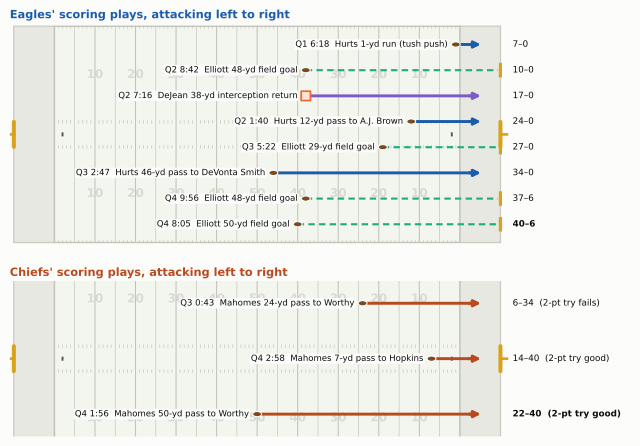
Every type of score except the safety showed up in a single game: Super Bowl LIX, February 9, 2025, at the Caesars Superdome in New Orleans, the Eagles’ 40–22 win over the Chiefs that ended the 2024 season.33 Here is every scoring play, located on the field.

Show the Python
PHI = [("Q1 6:18", "Hurts 1-yd run (tush push)", "td", 1, "7–0"),
       ("Q2 8:42", "Elliott 48-yd field goal", "fg", 48, "10–0"),
       ("Q2 7:16", "DeJean 38-yd interception return", "ret", 38, "17–0"),
       ("Q2 1:40", "Hurts 12-yd pass to A.J. Brown", "td", 12, "24–0"),
       ("Q3 5:22", "Elliott 29-yd field goal", "fg", 29, "27–0"),
       ("Q3 2:47", "Hurts 46-yd pass to DeVonta Smith", "td", 46, "34–0"),
       ("Q4 9:56", "Elliott 48-yd field goal", "fg", 48, "37–6"),
       ("Q4 8:05", "Elliott 50-yd field goal", "fg", 50, "40–6")]
KC = [("Q3 0:43", "Mahomes 24-yd pass to Worthy", "td", 24, "6–34", "2-pt try fails"),
      ("Q4 2:58", "Mahomes 7-yd pass to Hopkins", "td", 7, "14–40", "2-pt try good"),
      ("Q4 1:56", "Mahomes 50-yd pass to Worthy", "td", 50, "22–40", "2-pt try good")]

fig, axes = plt.subplots(2, 1, figsize=(6.6, 4.75),
                         gridspec_kw=dict(height_ratios=[FIELD_WIDTH + 1, FIELD_WIDTH - 15]))
for ax, plays_, team, col in ((axes[0], PHI, "Eagles", style.OFFENSE_DARK), (axes[1], KC, "Chiefs", style.DEFENSE_DARK)):
    n = len(plays_)
    margin = 4.5 if team == "Eagles" else 13.0
    fld = Field(ax=ax, orient="horizontal", window=None, los=60, to_go=None,
                lateral=None if team == "Eagles" else (8.0, FIELD_WIDTH - 8.0))
    field_extras(fld, pylons=False, border=False)
    for t in ax.texts:
        t.set_alpha(0.25)
    top = FIELD_WIDTH - margin
    gap = (top - margin) / max(1, n - 1)
    for i, play in enumerate(plays_):
        when, what, kind, yl, score = play[:5]
        y = top - i * gap
        if kind == "fg":
            x0 = 120 - yl                                  # the hold: kick distance is measured to the posts
            ax.plot([x0, 119.4], [y, y], color=style.THIRD, lw=1.6, ls=(0, (3, 2)), zorder=5)
            ax.plot([120, 120], [y - 1.4, y + 1.4], color=GOLD, lw=2.4, zorder=6)
            football(ax, x0, y, w=2.2, h=1.3)
        else:
            x0 = 110 - yl
            c = "#7a5cc4" if kind == "ret" else col
            ax.plot([x0, 113.5], [y, y], color=c, lw=2.2, zorder=5, solid_capstyle="round")
            arrow(ax, (112.0, y), (115.5, y), color=c, lw=2.2, head=10)
            if kind == "ret":
                draw_marker(ax, x0, y, "def", "", 6, r=1.3)
            else:
                football(ax, x0, y, w=2.2, h=1.3)
        ax.text(x0 - 2.0, y, f"{when}  {what}", fontsize=6.4, ha="right", va="center", color=style.INK, zorder=8,
                bbox=dict(boxstyle="round,pad=0.12", fc=style.SURFACE, ec="none", alpha=0.97))
        extra = f"  ({play[5]})" if len(play) > 5 else ""
        ax.text(123.0, y, score + extra, fontsize=6.6, ha="left", va="center", color=style.INK,
                fontweight="bold" if i == n - 1 else "normal")
    ax.text(0, 1.015, f"{team}' scoring plays, attacking left to right", transform=ax.transAxes, fontsize=8.5,
            fontweight="bold", color=col, ha="left", va="bottom")
    ax.set_xlim(-1, 152)
    blank(ax)
fig.subplots_adjust(hspace=0.1, left=0.01, right=0.99, top=0.95, bottom=0.01)
plt.show()
Figure 3.11: Super Bowl LIX, every scoring play, each drawn with the scoring team attacking left to right (in the real game the direction changed from quarter to quarter). Solid lines are touchdowns, starting at the line of scrimmage; the purple line, starting at an orange square, is Cooper DeJean’s interception return, starting where he caught the ball; green dashed lines are field goals, starting at the spot of the hold. The running score is at the right. Data: nflverse play-by-play.
NoteFilm room: Eagles 2024 — Super Bowl LIX, every score

Read the Eagles’ panel from the top and you get a tour of this chapter.

  • The goal line is in. The first touchdown came from a yard out, Jalen Hurts pushed forward by his own teammates in the Eagles’ famous short-yardage play, the tush push. One yard is all it took because the ball only had to touch the plane.
  • Defenses score too. Cooper DeJean intercepted Patrick Mahomes at the Kansas City 38 and ran it back for a touchdown: six points for the Eagles while their offense sat on the bench.
  • Seven and three. Philadelphia’s scoring was four touchdowns, all followed by Jake Elliott extra points (28 points), and four Elliott field goals (12 points): 48, 29, 48 and 50 yards. Check the arithmetic on the field: the 50-yarder came from the Chiefs’ 32, the 29-yarder from their 11, the 48-yarders from their 30. Line of scrimmage plus 18, every time. The 29-yarder is the one drive where the Chiefs’ defense won the 7-versus-3 battle in the red zone: the Eagles reached the 11 and settled for three.
  • Going for two when far behind. Kansas City scored three touchdowns, all after the game was decided, and went for two after every one (one failed, two succeeded): 6 + 8 + 8 = 22. When you trail by four scores, one extra point barely matters, and two might cut the number of scores you need.
  • The clock. It was 24–0 at halftime, which is a hard reset: Kansas City got the second-half kickoff and new timeouts, but no amount of clock management fixes a 24-point hole when an average possession is worth about two points.

What to notice when you watch it again: where each drive stalled. The Eagles’ field goals mark the drives the Chiefs’ defense held to three; the gap between those four kicks and four more touchdowns would have been 16 points. The Chiefs’ own drives stalled for a different reason: Philadelphia kept Patrick Mahomes under pressure while rushing only four, a story for the pass-rush chapters.

TipWatch for it on Sunday: the clock watcher

Pick one quarter (the second or fourth is best, because of the two-minute warning). Before every snap, say out loud whether the game clock is running, and why.

  • Running? Look at the score bug (the score-and-clock box in a corner of the screen) before the snap. If it’s ticking, the last play ended with a tackle in bounds. Say “tackled in bounds.”
  • Stopped? Name the reason: incompletion, out of bounds, timeout, flag, score, change of possession, two-minute warning.
  • Out of bounds early in the half? Watch the clock start again on the referee’s signal, before the snap. Then watch it stay stopped until the snap after the two-minute warning.
  • Count the timeouts shown in the score bug for each team, and notice when announcers start talking about them.
  • Bonus: the hash. On each snap, note whether the ball is on the left hash, the right hash or the middle, and whether the play went to the wide side or the short side.

By the end of one quarter you won’t need the chart above. You’ll feel when the clock should be running.

Predict the play

TipPredict the play 1: which side is the wide side?
Show the Python
trips = {"Z": dict(d=-0.7), "H": dict(w=-11.5), "Y": dict(d=-1.5, w=-7.0)}   # true trips: Z on the line, Y detached
off1 = [q.moved(**trips[q.key]) if q.key in trips else q for q in ch1(offense("gun_trips", strength="left"))]
p = Play(off1, None, los=50, ball_y="right", to_go=10)
fld = p.draw(window=(-7.5, 12), lateral="full", title=False)
hide_numbers(fld.ax)
plt.show()
Figure 3.12: First-and-10 at the offense’s own 40. The offense lines up three receivers on one side (Z, H and Y) and leaves one (X) alone on the other. Find the hash marks first.

Which side of this formation is the field side? Why would the offense put its three receivers there, and what does it give up?

The left side is the field (wide) side. The ball is on the right hash, so there’s about 30 yards between the ball and the left sideline and about 24 to the right sideline. The offense put its three receivers into the bigger space so they have room to spread out and run routes that break away from each other, and so a run or screen to that side has room to get outside. The single receiver goes into the boundary, where he works one-on-one against his defender, with the sideline close by.

What it gives up: three receivers to the field tells the defense where most of the offense’s options are. Defenses that play “field” and “boundary” roles can slide their safeties toward the wide side and leave the boundary corner alone against X. That is exactly the one-on-one some offenses want, if X is their best receiver. You’ll see both versions every Sunday: “formation to the field” is the common default, and lining up into the boundary is a deliberate surprise. (Spread and Modern Formations names this formation; for now, just find the wide side.)

TipPredict the play 2: out of bounds, or not?
Show the Python
off2 = ch1(offense("gun_2x2"))
h_w = next(q_.w for q_ in off2 if q_.key == "H")
fix2 = {"RCB": dict(d=6.0, w=16.5),          # outside Z: outside leverage on the sideline throw
        "WILL": dict(d=4.5, w=h_w + 1.5)}    # walked out to an apex over the slot H
dfn2 = [d_.moved(**fix2[d_.key]) if d_.key in fix2 else d_ for d_ in defense("nickel", "two_high", offense("gun_2x2"))]
q = Play(off2, dfn2, los=70, to_go=10)
q.dropback(1.0)
q.route("Z", r.out(9, 6.5))
time_pass(q, "Z")
q.run("Z", [(0.5, 4.9)])
q.path("RCB", [(9.4, 20.6)], absolute=True)  # drives on the out
q.highlight("Z")
fld = q.draw(window=(-7.5, 17), lateral="full", title=False)
hide_numbers(fld.ax)
fld.ax.text(0.015, 0.97, "Q4  3:12\nTrailing 20–24\nNo timeouts left", transform=fld.ax.transAxes, fontsize=8,
            va="top", ha="left", color=style.INK, fontweight="bold", zorder=20,
            bbox=dict(boxstyle="round,pad=0.35", fc=style.SURFACE, ec=style.INK_2, lw=0.8))
plt.show()
Figure 3.13: First-and-10, fourth quarter, 3:12 left, the offense trailing 20–24 with no timeouts. Z (outlined) runs a 9-yard out, catches the ball near the sideline and steps out of bounds, a yard short of the line to gain. On defense, C is a cornerback, $ the nickel back (a fifth defensive back), FS and SS the two deep safeties, M and W linebackers, E and T linemen.

The clock stopped when Z stepped out. When will it start again? Would your answer change if this had happened with 6:12 left instead of 3:12?

At 3:12 it stays stopped until the next snap. Inside the last five minutes of the game, a play that ends out of bounds stops the clock until the ball is snapped again. The offense, with no timeouts, gets a “free” stoppage just by getting its receiver out, which is exactly why it threw to the sideline. It can now take its time choosing a play for second-and-1 without burning clock. And it has one more stoppage coming that it doesn’t have to pay for: the two-minute warning, which coaches count as a fourth timeout.

At 6:12 the answer changes. Earlier in the half, the clock stops only until the officials have re-spotted the ball on the hash and the referee signals ready for play. Then it starts again, and the play clock is running too, so the offense loses most of the advantage.

Now think like the defense, which is protecting a 4-point lead. It wants the clock running, so it would much rather tackle Z in bounds, even after a few more yards, than let him get out. That’s why the corner in the picture lines up a yard outside Z: in this situation defensive backs take away the sideline throw and concede the catch over the middle, where a tackle keeps the clock running. Here the offense completed the out anyway, exactly the throw the defense was set up to prevent.

TipPredict the play 3: three points or seven?
Show the Python
gl = [q.moved(label="H") if q.key == "W" else q for q in ch1(offense("goal_line"))]
GL_D = [Player("LE", "DE", "def", 1.0, -4.8, label="E"),    # 6-technique, head-up on U
        Player("LT_", "DT", "def", 1.0, -2.35, label="T"),  # outside shade of the left guard (B gap)
        Player("LN", "NT", "def", 1.0, -0.8, label="N"),    # left A gap
        Player("RN", "NT", "def", 1.0, 0.8, label="N"),     # right A gap
        Player("RT_", "DT", "def", 1.0, 4.1, label="T"),    # inside shade of Y (C gap)
        Player("RE", "DE", "def", 1.0, 6.2, label="E"),     # head-up on the wing
        Player("MIKE", "MIKE", "def", 2.3, -2.0, label="M"),
        Player("WILL", "WILL", "def", 2.3, 2.0, label="W"),
        Player("LCB", "CB", "def", 1.2, -7.0, label="C"),
        Player("RCB", "CB", "def", 1.2, 8.4, label="C"),
        Player("SS", "SS", "def", 4.0, 0.6, label="SS")]
g = Play(gl, GL_D, los=109, to_go=1)
fld = g.draw(window=(-9, 11), lateral=(-14, 14), title=False)
field_extras(fld, border=False)
plt.show()
Figure 3.14: Fourth-and-goal at the 1 (‘and-goal’: the line to gain is the goal line itself, drawn in yellow), second quarter, score tied 7–7. The offense has sent out its heavy goal-line group: three tight ends (U and Y on the line, H a step behind as a wing), a fullback (F) and a running back (R). The defense has answered with a goal-line front: six linemen (E, T, N) filling every gap, two linebackers (M, W) 2 yards off the ball, a cornerback (C) outside each end and one safety (SS). The kicker is warming up on the sideline.

Kick the field goal or go for the touchdown? Put a number on each choice.

Go for it, and most NFL coaches now would. Do it in points:

  • The field goal is a 19-yarder (the 1 plus 18). From there kickers almost never miss: in the 2016–2025 regular seasons, 99% of field goals tried on fourth-and-goal from the 1 or 2 were good. Call it 3 points.
  • Going for it from the 1 or 2 scored a touchdown 55% of the time in the same seasons (the number from the 7-versus-3 section). A touchdown plus an extra point (about 96% good) is worth almost 7, so on average going for it is worth about 0.55 × 6.96 ≈ 3.8 points.

Going for it wins on raw points, and that’s before counting the miss. If the offense fails, the opponent takes over at its own 1-yard line, the worst field position in football. NFL teams starting a drive there have been, on average, slightly more likely to give up the next score than to get it. If the kick succeeds, the opponent gets a kickoff and usually starts around its own 30–35, a much better spot. So even the failure case isn’t a disaster, and the success case is worth four extra points.

That’s why teams have changed their behavior: on fourth-and-goal from the 1 or 2, NFL teams went for it 57% of the time in 2016 and 85% of the time in 2025. The crowd at the top of the chapter wasn’t being irrational when it booed the kicker. It was doing the 7-versus-3 math. How teams turn this into a fourth-down model, and when the answer flips (late in a game, the score matters more than the average), is in Win Probability and Decision Analysis.

Takeaways

  • The field is a 120-yard grid: a 100-yard field of play and two 10-yard end zones. The goal line is in the end zone, and only the ball has to break its plane; the sidelines and end lines are out, and any part of the player touching them is enough.
  • Every play starts on or between the hash marks. With the ball on a hash, the field splits into a wide (field) side and a short (boundary) side, and offenses and defenses plan by them. The NFL’s hashes are narrow, so its field is nearly symmetrical; college’s wider hashes make the wide side huge.
  • Points come in a handful of sizes: 6 for a touchdown, then 1 (kick from the 15) or 2 (play from the 2) on the try, 3 for a field goal, and 2 plus the ball for a safety. The four-point gap between 7 and 3 drives red-zone play, fourth-down decisions and late-game math.
  • Possessions are scarce, about 10 or 11 per team per game, and a team only gets the ball back by stopping the other team or after the other team scores.
  • The game clock keeps running after a tackle in bounds and stops for incompletions, out-of-bounds plays, scores, changes of possession, timeouts and flags; out of bounds stops it until the snap only late in each half. The play clock gives the offense 40 seconds (or 25) to snap. Trailing teams fight to stop the game clock; leading teams make the two clocks run together.
  • A game is four 15-minute quarters with a two-minute warning near the end of each half (after the last play snapped before 2:00), a halftime that resets possession and timeouts, and an overtime in which, since 2025, both teams get the ball in every game.

Connections

Builds on: nothing. This is the first chapter.

Sets up: Downs, Distance, and Field Position puts the grid to work: four downs, the line to gain, and field position as a currency, with a first look at expected points, the number that prices the 7-versus-3 choice exactly. The Twenty-Two puts players on the field, including the kicker, holder and long snapper behind every field goal. What a Play Really Is fills the 40 seconds of the play clock. Further on: Kicking and Punting and Kickoffs and Returns (the kicking game and its fast-changing rules), Red Zone, Goal Line, and Short Yardage, Clock and Game Management (overtime, the out-of-bounds rule, the 10-second runoff and every late-game clock decision), and Win Probability and Decision Analysis.

Case studies: the 2024 Eagles’ goal-line game and the tush push appear again in Red Zone, Goal Line, and Short Yardage; Andy Reid’s Chiefs, on both ends of this chapter’s film rooms, are the subject of Andy Reid’s Chiefs.

NoteGo deeper
  • The NFL rulebook is shorter and more readable than its reputation. Rule 1 (the field), Rule 4 (game timing) and Rule 11 (scoring) cover everything in this chapter, at operations.nfl.com.
  • NFL Football Operations’ “Learn the game” pages and its glossary of football terms are a good plain-English companion.
  • Pat Kirwan, Take Your Eye Off the Ball (2010; 2nd ed. 2015): written by a former NFL coach and scout for fans; good on how the field’s landmarks shape what players do.
  • The Pro Football Hall of Fame’s year-by-year history pages trace how hash marks, goal posts and scoring rules got where they are.

  1. David Biderman, “11 Minutes of Action,” The Wall Street Journal (Jan. 15, 2010), which timed four broadcasts from one late-December weekend and found an average of about 11 minutes of live play (10 minutes 43 seconds) in broadcasts of about three hours (174 minutes): https://www.wsj.com/articles/SB10001424052748704281204575002852055561406 (paywalled; the same study is summarized in a Fox Sports repost, “Football games have 11 minutes of action,” Jan. 18, 2010: https://www.foxsports.com/stories/nfl/football-games-have-11-minutes-of-action).↩︎

  2. NFL, Official Playing Rules of the National Football League (2026 edition), Rule 1, Sections 1–2 (a field 360 by 160 feet; end lines, sidelines and goal lines; the 6-foot white border; yard-line markings every 5 yards; inbounds lines “70 feet, 9 inches” from each sideline; 1-yard marks; field numerals whose bottoms begin 12 yards in from each sideline and that are 2 yards tall; the 1-yard-long marks two yards from each goal line; field-markings item 9, a white arrow beside the top of each number except the 50, “pointing toward the goal line”), and Rule 3, Section 11, Article 9 (yard lines are named “A’s 19,” “B’s 49”): https://operations.nfl.com/the-rules/nfl-rulebook/ . Cited below as “NFL rulebook (2026)”.↩︎

  3. The 1881 convention set the field at 110 by 53⅓ yards, and the width has stayed 160 feet ever since (the end zones came later): Pigskin Dispatch, “1881 Football History”: https://pigskindispatch.com/1881-football-history/ .↩︎

  4. NFL rulebook (2026), Rule 11, Section 2, Article 1 (a touchdown when the ball is “on, above, or behind the plane of the opponent’s goal line,” including a ball that passes “over or inside the pylon”); Rule 3, Section 11, Article 3 (“The goal line and the pylons are in the end zone”); Rule 3, Section 20, Article 1 (a player is out of bounds “when he touches a boundary line”).↩︎

  5. NFL rulebook (2026), Rule 1, Section 3: a crossbar 18 feet 6 inches long whose top is 10 feet above the ground, “in the plane of each end line,” and uprights that “extend 35 feet above the crossbar”.↩︎

  6. NFL rulebook (2026), Rule 11, Section 3, Article 1(a) (the team that scored puts the ball in play for the try “anywhere on or between the inbound lines”) and Rule 11, Section 6, Article 3 (after a touchback the ball is snapped “from any point on or between the inbounds lines”).↩︎

  7. Pro Football Hall of Fame, “The First Playoff Game”: the December 18, 1932 Bears–Spartans game was moved into Chicago Stadium on a field “only 80 yards long and 30 feet narrower” than regulation, with “the sidelines butted up against the stands”; for 1933 the league required “the ball be spotted on the hashmarks on every play” and moved the goal posts “from the end line to the goal line”: https://profootballhof.com/football-history/the-first-playoff-game . Accounts of the game’s special sideline rule differ (some say the ball went to inbounds lines 10 yards from the walls, others that it could be brought in 15 yards at the cost of a down): “1932 NFL Playoff Game,” Wikipedia: https://en.wikipedia.org/wiki/1932_NFL_Playoff_Game . Before 1933, “all plays began where the ball was declared dead”: “Hash mark (sports),” Wikipedia: https://en.wikipedia.org/wiki/Hash_marks↩︎

  8. Pro Football Hall of Fame, NFL history by year: 1933 (“inbounds line or hashmarks … adopted” from the 1932 game), https://www.profootballhof.com/football-history/football-history/1869-1939/1933 ; 1935 (“moved nearer the center of the field, 15 yards from the sidelines”), https://www.profootballhof.com/football-history/football-history/1869-1939/1935 ; 1945 (“moved from 15 yards away from the sidelines to nearer the center of the field - 20 yards from the sidelines”), https://www.profootballhof.com/football-history/football-history/1940-1959/1945 ; 1972 (“moved nearer the center of the field, 23 yards, 1 foot, 9 inches from the sidelines”), https://www.profootballhof.com/football-history/football-history/1960-1979/1972 . The 1933 distance (10 yards, i.e. 30 feet) is from “Hash mark (sports),” Wikipedia: https://en.wikipedia.org/wiki/Hash_marks↩︎

  9. The motive: the Associated Press report of the owners’ vote ran as “Owners give offense big seven-yard boost” (Rome News-Tribune, Mar. 24, 1972, p. 6A, cited in “1972 NFL season,” Wikipedia: https://en.wikipedia.org/wiki/1972_NFL_season); Sports Illustrated, “High on the Hash” (Aug. 28, 1972), tied it to the low scoring of 1971: https://vault.si.com/vault/1972/08/28/high-on-the-hash↩︎

  10. NFL Football Operations, 2026 rulebook page, field markings: “The location of the inbounds hash marks is 70’ 9” for professional football, 60’ for college football” (the NCAA rules, Rule 1-2, likewise put the inbounds lines 60 feet from the sidelines). College hashes have been 40 feet apart since 1993, the spacing the NFL used from 1945 to 1971, and high-school hashes are 53 feet 4 inches from each sideline: “Hash mark (sports),” Wikipedia, citing the Milwaukee Journal (Mar. 26, 1993): https://en.wikipedia.org/wiki/Hash_marks↩︎

  11. NFL rulebook (2026), Rule 11, Section 1, Article 2 (touchdown 6, field goal 3, safety 2, try 1 or 2); Rule 11, Section 3 (the try: snapped “15 yards from the defensive team’s goal line for a Try kick” or “two yards” for a run or pass; the game clock does not run; two points for a touchdown by either team; one point to the opponent for what would ordinarily be a safety against either team); Rule 4, Section 8, Article 2(c) (a try after a touchdown on the last play of a period is still made, except in sudden-death overtime or when time in the fourth period has expired and a try could not affect the outcome).↩︎

  12. NFL.com, “NFL moves extra point to 15-yard line for 2015 season” (May 2015), which also reports the new rule letting the defense return a blocked kick or failed two-point try for two points: https://www.nfl.com/news/nfl-moves-extra-point-to-15-yard-line-for-2015-season-0ap3000000493347↩︎

  13. Pro Football Hall of Fame, “2-point conversion turns 30 years old” (2024): https://www.profootballhof.com/news/2-point-conversion-turns-30-years-old ; Deseret News, “NFL officially adopts 2-point conversion” (Mar. 23, 1994): https://www.deseret.com/1994/3/23/19098606/nfl-officially-adopts-2-point-conversion/ . College football has used it since 1958 and the AFL used it from 1960 to 1969 (same PFHOF article).↩︎

  14. Course calculation from nflverse play-by-play, regular seasons 2010–2025: rows with an extra_point_result (kicks) or a two_point_conv_result (two-point tries), success = “good” or “success”. Tries nullified by penalties are not counted.↩︎

  15. NFL rulebook (2026), Rule 11, Section 4, Article 2 (missed field goals: “If the spot of the kick was inside the receivers’ 20-yard line, it is the receivers’ ball at the 20-yard line”; otherwise “at the spot of the kick”).↩︎

  16. Course calculation from nflverse play-by-play, regular seasons: all field-goal attempts by kick_distance, 2021–2025 for the chart; 2025 alone for the count of made kicks of 60+ yards. Kicks of 50+ yards were made 57% of the time in 2016 and 58% in 2019, against 69–70% in every season from 2022 to 2025.↩︎

  17. Pro Football Hall of Fame, NFL history by year, 1974 (“the goal posts were moved from the goal line to the end lines,” part of a package of changes adopted “to add action and tempo to games”): https://www.profootballhof.com/football-history/football-history/1960-1979/1974 . On the purpose, Nexstar Media, “NFL goalposts used to look very different: What changed, and why they moved” (2025), citing the Hall of Fame: the move was made “in an effort to force offenses to play for touchdowns instead of field goals,” and attempts fell from more than 860 the season before to 553: https://www.abc27.com/news/nfl-goalposts-used-to-look-very-different-what-changed-and-why-they-moved/↩︎

  18. NFL rulebook (2026), Rule 11, Section 5 (what is a safety; after a safety, “the team scored upon must put the ball in play by a free kick (punt, drop kick, or place kick) from its 20-yard line”). . The count is a course calculation from nflverse play-by-play (safety == 1), 2025 regular season, 272 games. The starting spot is the first run or pass after each safety in the 2016–2025 regular seasons (137 safeties), median taken.↩︎

  19. Course calculation from nflverse play-by-play, 2025 regular season (272 games): one row per drive (fixed_drive), classified by fixed_drive_result; a red-zone trip is a drive with drive_inside20 == 1; points per team are final scores averaged over both teams.↩︎

  20. Course calculation from nflverse play-by-play, 2016–2025 regular seasons (also used in the third Predict-the-play answer): fourth-and-goal snaps from the 1 or 2 (593 plays): runs and passes scored a touchdown on 55% (236 of 426); field goals were good on 99% (166 of 167); teams went for it on 57% of these snaps in 2016 and 85% in 2025. Expected points for a first-and-10 at a team’s own 1-yard line averaged about −0.5 in 2023–2025 (nflverse ep), against about +1.6 at its own 35.↩︎

  21. The option to defer was added in 2008. Coin-toss winners deferred 8% of the time in 2008 and 76% in the first half of the 2015 season (Ben Goessling, ESPN, Nov. 5, 2015, “For NFL teams, deferring after winning coin toss is more than a 50-50 choice”: https://www.espn.com/blog/nfcnorth/post/_/id/72630/for-nfl-teams-deferring-after-winning-coin-toss-is-more-than-a-50-50-choice) and about five times in six by 2018 (Zach Barnett, FootballScoop, “The number of NFL coaches deferring the kickoff has skyrocketed in the past decade,” Sept. 7, 2018: https://footballscoop.com/news/number-nfl-coaches-deferring-kickoff-skyrocketed-past-decade).↩︎

  22. NFL rulebook (2026), Rule 4, Section 1 (four 15-minute periods; at least two minutes between the first and second and the third and fourth periods; a 13-minute halftime) and Section 2 (the visiting captain calls the coin toss; the winner may defer; for the second half the loser of the toss has first choice unless the winner deferred; teams change goals after the first and third periods with possession, down, ball position and line to gain unchanged).↩︎

  23. NFL.com, “NFL owners vote to make dynamic kickoff permanent, adjust ball spot on touchbacks to 35-yard line” (2025): https://www.nfl.com/news/nfl-owners-vote-to-make-dynamic-kickoff-permanent-adjust-ball-spot-on-touchbacks-to-35-yard-line ; Seattle Seahawks, “NFL announces approved rule changes for 2026 season” (onside kick declarable at any time): https://www.seahawks.com/news/nfl-announces-approved-rule-changes-for-2026-season . The kicker’s restraining line is the kicking team’s 35 (2026 rulebook, Rule 6, Section 1, Article 2).↩︎

  24. NFL rulebook (2026), Rule 3, Section 41: “an automatic timeout that occurs at the conclusion of the last down for which the ball is legally snapped or kicked prior to two minutes remaining on the game clock in the second and fourth periods.” On its origin: Football Zebras, “NFL100: For half of NFL history, the official time was not on the scoreboard” (Oct. 2019), which notes that official time moved to the scoreboard when the NFL adopted the AFL’s rule at the 1970 merger and that “the two-minute warning was just that — an official notification to both sidelines”: https://www.footballzebras.com/2019/10/nfl100-for-half-of-nfl-history-the-official-time-was-not-on-the-scoreboard↩︎

  25. NFL Football Operations, “Featured rules” (overtime: playoffs since 2022 and regular season since 2025, both teams possess; regular-season period of 10 minutes, ties possible): https://operations.nfl.com/rules-officiating/featured-rules ; ESPN, NFL rule changes for 2025: https://www.espn.com/nfl/story/_/id/46088927/nfl-rules-changes-tush-push-chain-gang-kickoffs-celebrations . Timeouts in overtime: 2026 rulebook, Rule 4, Section 5, Article 1; the new coin toss at the end of regulation: Rule 16, Section 1, Article 2.↩︎

  26. Course calculation from nflverse play-by-play, 2025 regular season: runs, passes, punts, field goals, extra points, kickoffs, kneels and spikes per game, both teams together (about 149), of which runs and passes about 121.↩︎

  27. NFL rulebook (2026), Rule 4, Section 3 (starting the game clock: after a free kick “when the ball is legally touched in the field of play”; after a runner goes out of bounds, “on the Referee’s signal that a ball has been returned to play,” except on the snap after a change of possession, after the two-minute warning of the first half, or inside the last five minutes of the second half; after fouls, generally “as if the foul had not occurred,” with late-game exceptions; a fumble that goes out of bounds restarts the clock on the ready signal at any time of the game, 4-3-2-f) and Section 4 (stopping the game clock); Rule 4, Section 7, Article 1 (10-second runoff for the offense’s time-conserving acts after the two-minute warning) and Section 5, Article 4, Note 9 (“There can never be a 10-second runoff against the defensive team”).↩︎

  28. Super Bowl XLVI (Feb. 5, 2012): Sports Illustrated, “Bradshaw’s Reluctant Touchdown puts to rest an unusual Super Bowl” (Feb. 6, 2012), on Belichick telling his team “to let the Giants score”: https://www.si.com/more-sports/2012/02/06/super-bowlxlvi ; play times and score from nflverse play-by-play, game 2011_21_NYG_NE (Bradshaw’s 6-yard touchdown at 1:04, failed two-point try, New England ball at 0:57). Eagles at Cowboys (Dec. 16, 2007): NFL.com, “Westbrook heeded Runyan’s advice on stopping at 1”: https://www.nfl.com/_amp/westbrook-heeded-runyan-s-advice-on-stopping-at-1-09000d5d805331ad ; nflverse play-by-play, game 2007_15_PHI_DAL (Dallas’s third timeout at 2:19, Westbrook’s 24-yard run to the Dallas 1, then three Donovan McNabb kneel-downs).↩︎

  29. ESPN, “NCAA approves rule change to run clock after first downs” (Apr. 21, 2023; the change applies in every division except Division III, and the clock still stops after first downs in the last two minutes of each half): https://www.espn.com/college-football/story/_/id/36255797/ncaa-approves-rule-change-run-clock-first-downs↩︎

  30. NFL rulebook (2026), Rule 4, Section 5, Article 1: “three charged team timeouts during each half and two timeouts during an overtime period in the regular season”; a second timeout by the defense to “freeze” a kicker is unsportsmanlike conduct (Item 4).↩︎

  31. NFL rulebook (2026), Rule 4, Section 6, Articles 1–2: “within 40 seconds after the start of the play clock,” which starts “when a play ends”; 25 seconds “beginning with the Referee’s whistle” after administrative stoppages including a change of possession, a charged team timeout, the two-minute warning, the expiration of a period and a penalty enforcement.↩︎

  32. Play sequence, times and scores from nflverse play-by-play, game 2021_20_BUF_KC (Jan. 23, 2022), including the touchbacks, the timeouts at 0:08 and 0:03, Harrison Butker’s 49-yard field goal and the overtime touchdown; the overtime rule changes as in the NFL Football Operations “Featured rules” page and this course’s fact sheet (checked 2026-10-06).↩︎

  33. Date, venue, score and MVP (Jalen Hurts) as in this course’s fact sheet (checked 2026-10-06), e.g. CBS News, “Jalen Hurts named Super Bowl MVP”: https://www.cbsnews.com/amp/news/nfl-mvp-super-bowl-jalen-hurts-eagles . Every scoring play, its time, spot and kick distance from nflverse play-by-play, game 2024_22_KC_PHI. The Eagles’ pressure came from four-man rushes (same fact sheet).↩︎